Hashimoto’s thyroiditis is an autoimmune disorder in which the immune system targets the thyroid gland. Over time, the resulting inflammation can damage thyroid tissue and reduce the gland’s ability to produce enough thyroid hormone. It is the most common cause of hypothyroidism in iodine-sufficient areas and the leading cause of hypothyroidism in the United States.
Thyroid hormones influence how the body uses energy and affect functions throughout the body, including heart rate, body temperature, digestion, muscles and the nervous system. This is why declining thyroid function can produce symptoms that initially appear unrelated.
KEY FACT
Hashimoto’s thyroiditis does not automatically mean hypothyroidism. A person can have thyroid antibodies and autoimmune inflammation while their thyroid hormone levels remain normal. In this situation, thyroid hormone treatment is generally not required, but thyroid function should be monitored over time.
How common is Hashimoto’s thyroiditis?
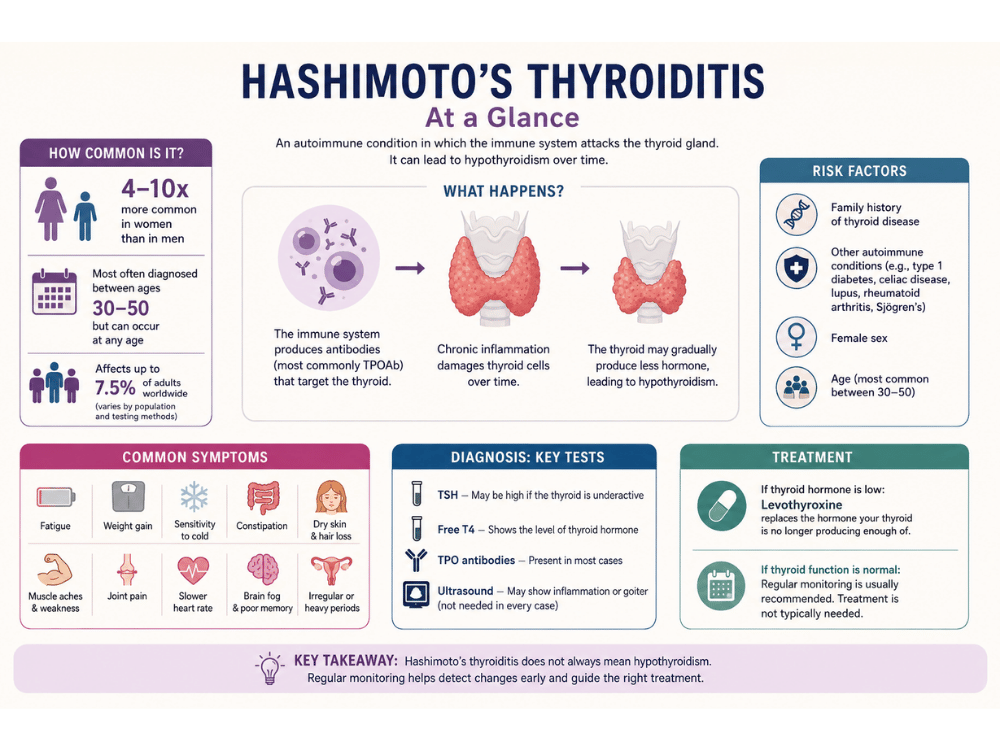
Hashimoto’s occurs considerably more often in women than in men. The US National Institute of Diabetes and Digestive and Kidney Diseases reports that it is approximately four to ten times more common in women and is most often diagnosed between the ages of 30 and 50, although it can occur at any age.
A large systematic review and meta-analysis involving data from 48 studies estimated the global prevalence of Hashimoto’s thyroiditis in adults at approximately 7.5%. Prevalence varied significantly between populations, geographical regions and diagnostic methods, so this figure should be considered an overall estimate rather than a universal rate. The analysis also found a substantially higher prevalence among women.
Family history is another important factor. Hashimoto’s often runs in families, reflecting a genetic component to susceptibility.
People with certain other autoimmune diseases are also more likely to develop Hashimoto’s, including type 1 diabetes, coeliac disease, rheumatoid arthritis, lupus and Sjögren’s syndrome.
Hashimoto’s does not always mean an underactive thyroid
One of the most useful distinctions to understand is the difference between thyroid autoimmunity and hypothyroidism.
A person may have elevated thyroid antibodies while their thyroid continues to produce normal levels of hormone. This is sometimes referred to as euthyroid Hashimoto’s thyroiditis.
The American Thyroid Association states that people with elevated thyroid antibodies but normal TSH and free T4 generally do not require thyroid hormone treatment simply because antibodies are present. Thyroid function should instead be monitored because some people will eventually develop hypothyroidism.
As thyroid damage progresses, the gland may gradually become unable to produce enough hormone.
In subclinical hypothyroidism, TSH is elevated while free T4 remains within the reference range. Whether treatment is required depends on the individual circumstances.
In overt hypothyroidism, TSH is elevated and circulating thyroid hormone is low.
Rarely, early inflammation can cause stored thyroid hormone to leak from damaged thyroid cells, temporarily producing symptoms of an overactive thyroid before thyroid function later declines.
What are the symptoms?
Many people with Hashimoto’s have no symptoms initially. When symptoms develop, they are commonly related to the hypothyroidism caused by progressive thyroid damage.
Symptoms may include:
persistent tiredness
weight gain
increased sensitivity to cold
constipation
dry skin
dry or thinning hair
muscle aches or weakness
joint discomfort
slower heart rate
difficulty exercising
heavy or irregular menstrual periods
fertility problems
low mood or depression
problems with concentration or memory.
These symptoms are not specific to thyroid disease. Fatigue, weight changes, hair loss and low mood, for example, can have many different causes. Laboratory testing is therefore essential rather than diagnosing Hashimoto’s based on symptoms alone.
Hashimoto’s can also cause enlargement of the thyroid gland, known as a goitre. This can create swelling at the front of the neck or a feeling of fullness in the throat.
Interestingly, after many years or decades of autoimmune damage, the opposite can occur. The thyroid may gradually shrink as functioning thyroid tissue is lost.
Why can diagnosis be challenging?
Because many symptoms of hypothyroidism are common in the general population, blood tests play a central role in diagnosis.
Assessment may include:
TSH
Thyroid-stimulating hormone, or TSH, is one of the principal tests used to assess thyroid function. When the thyroid struggles to produce sufficient hormone, TSH commonly rises as the pituitary gland increases its signal to the thyroid.
Free T4
Free thyroxine helps establish how much circulating thyroid hormone is available and whether hypothyroidism is overt or subclinical.
Thyroid antibodies
Thyroid peroxidase antibodies, known as TPO antibodies, are present in most people with Hashimoto’s thyroiditis. Thyroglobulin antibodies may also be detected.
An important point is that antibody levels generally do not need to be repeatedly measured once Hashimoto’s has been established.
The American Thyroid Association notes that following thyroid antibody levels over time is not useful for determining whether hypothyroidism is developing or whether treatment is working. TSH and free T4 provide more useful information about actual thyroid function.
Thyroid ultrasound
Ultrasound is not routinely required in every person with Hashimoto’s.
It may be considered when the diagnosis remains uncertain, thyroid antibodies are absent despite clinical suspicion, the thyroid is enlarged, or nodules or other structural abnormalities need further investigation. Ultrasound can also show features of thyroid inflammation before hormone levels become abnormal.
How is Hashimoto’s treated?
There is currently no established therapy that reliably switches off or reverses the underlying autoimmune process.
Treatment therefore focuses on the thyroid dysfunction that Hashimoto’s may cause.
When thyroid function remains normal
If thyroid antibodies are elevated but TSH and free T4 remain normal, thyroid hormone treatment is usually not required.
Thyroid function should still be checked periodically because hypothyroidism may develop later.
Levothyroxine
When Hashimoto’s causes overt hypothyroidism, the standard treatment is levothyroxine, a synthetic form of thyroxine, or T4, equivalent to the main hormone normally produced by the thyroid gland.
The appropriate dose varies between individuals and can be influenced by age, body size, remaining thyroid function, pregnancy, other medical conditions and medications.
After starting levothyroxine or changing the dose, thyroid function is commonly checked after approximately six to eight weeks. Once the appropriate dose has been established, monitoring usually becomes less frequent.
Too much thyroid hormone is not harmless. Long-term overtreatment can contribute to problems including atrial fibrillation and reduced bone density, which is why treatment should be adjusted according to appropriate clinical and laboratory monitoring.
Medication absorption matters
Levothyroxine is highly effective when taken correctly, but its absorption can be affected by food, drinks and other medicines.
Coffee, soy and supplements or multivitamins containing calcium or iron can interfere with absorption when taken too close to the medication.
For this reason, levothyroxine is commonly taken consistently on an empty stomach, often 30 to 60 minutes before breakfast, according to the advice provided by the treating healthcare professional.
Liquid and soft-gel formulations are also available and can be useful for some people who experience difficulties absorbing conventional tablets.
What role does diet play?
There is currently no recognised universal “Hashimoto’s diet” that has been shown to reverse the disease.
People who have coeliac disease require a gluten-free diet because of coeliac disease itself. However, current evidence does not justify recommending a strict gluten-free diet to every person with Hashimoto’s solely because they have autoimmune thyroid disease.
Iodine requires particular care.
The thyroid needs iodine to produce thyroid hormone, but excessive intake can worsen thyroid dysfunction in susceptible people with autoimmune thyroid disease.
Large quantities of iodine-rich foods such as kelp and some seaweed products, as well as high-dose iodine supplements, should therefore not be assumed to be beneficial simply because iodine is required for thyroid function.
What about selenium?
Selenium is an essential trace element involved in several processes relevant to thyroid hormone metabolism and protection of thyroid tissue from oxidative damage.
It has therefore been studied extensively in Hashimoto’s thyroiditis.
A 2024 systematic review and meta-analysis published in Thyroid, the official journal of the American Thyroid Association, evaluated 35 studies.
Selenium supplementation was associated with a small reduction in TSH among participants who were not taking thyroid hormone replacement and with lower TPO antibody levels. However, researchers found no significant changes in free T4, T3, thyroglobulin antibodies or thyroid volume. Overall certainty of evidence was rated as moderate.
A more recent meta-analysis also reported reductions in TPO antibodies following selenium supplementation.
These findings are interesting, but their clinical meaning remains uncertain.
A reduction in antibody levels does not necessarily mean symptoms improve, thyroid damage is prevented or hypothyroidism can be avoided.
Selenium should therefore not be regarded as an alternative to levothyroxine when thyroid hormone replacement is required. Supplementation should also take existing dietary intake and individual nutritional status into account.
Hashimoto’s and pregnancy
Thyroid function becomes particularly important before and during pregnancy because maternal thyroid hormone contributes to normal foetal development, especially during early pregnancy.
The American Thyroid Association published completely updated guidelines for thyroid disease in preconception, pregnancy and postpartum care in May 2026, replacing recommendations dating from 2017. The new guidance covers thyroid autoimmunity, hypothyroidism, iodine requirements and thyroid function monitoring across the reproductive period.
Women already taking levothyroxine frequently require dose adjustment during pregnancy and should have thyroid function monitored appropriately.
Adequate iodine intake is also important because the developing baby depends on maternal iodine availability for thyroid hormone production. However, both inadequate and excessive iodine intake can cause problems, making appropriate professional guidance particularly important during pregnancy. Women with Hashimoto’s who are planning pregnancy should therefore discuss thyroid function and current treatment with their healthcare professional.
Looking beyond the thyroid
Hashimoto’s thyroiditis is associated with an increased likelihood of certain other autoimmune conditions, including type 1 diabetes, coeliac disease, rheumatoid arthritis, lupus and Sjögren’s syndrome.
This does not mean that everyone with Hashimoto’s needs screening for every autoimmune disorder.
It does mean that persistent or unexplained symptoms should not automatically be attributed to the thyroid, particularly when thyroid hormone levels are well controlled.
Fatigue, weight change, cognitive difficulties, hair loss and low mood have many potential explanations, and appropriate investigation may sometimes need to look beyond thyroid function.
Where is research heading?
Research continues into the mechanisms that cause the immune system to lose tolerance to thyroid tissue and into biomarkers that might help identify which people with thyroid antibodies are most likely to progress to hypothyroidism.
The relationship between nutrition, the gut microbiome and thyroid autoimmunity is also an active area of research.
However, this work has not yet established probiotic treatments, microbiome therapies, restrictive diets or immune-targeting biologic therapies as standard treatments for Hashimoto’s thyroiditis.
For now, the most important advances lie in increasingly precise diagnosis and management: recognising thyroid autoimmunity without automatically treating it, detecting thyroid dysfunction early, avoiding unnecessary supplementation and tailoring thyroid hormone replacement to the individual.
Living with Hashimoto’s thyroiditis
Hashimoto’s is usually a long-term condition, but the hypothyroidism it can cause can generally be controlled effectively with appropriate thyroid hormone replacement and monitoring.
Understanding the difference between thyroid antibodies, actual thyroid function and symptoms can also help patients make better sense of laboratory results and avoid unnecessary treatments or restrictive diets.
For people who do develop hypothyroidism, appropriately adjusted treatment can restore thyroid hormone levels and support normal everyday functioning.