THREE NUMBERS WORTH KNOWING BEFORE YOU READ FURTHER
- 1 in 3. The share of U.S. adults living with prediabetes, roughly 4 in 5 of whom do not know it.[1]
- 1 in 8. The share of adults worldwide living with impaired glucose tolerance, the clinical term for prediabetes.[9]
- Up to 70%. The share of people with prediabetes who eventually develop type 2 diabetes without intervention, a risk that structured lifestyle change cuts by roughly half.[4][5]
Prediabetes occupies an unusual place in clinical medicine. It is not a disease in the way type 2 diabetes is a disease, but a laboratory-defined window, measurable years before diabetes itself, during which the trajectory is still reversible for most people who have it. That window is also enormous: hundreds of millions of adults worldwide fall inside it, and a growing share of adolescents do too, often without a single symptom to flag the change.
This overview updates the clinical picture for both adults and children. It covers how prediabetes is actually diagnosed, why the large majority of cases go undetected, what the strongest available evidence supports for reversing course, where nutrition and nutraceutical formulations responsibly fit alongside lifestyle change and medication, and what the global distribution of this condition means for the organizations that supply the products used to manage it.
What Prediabetes Actually Is
Prediabetes describes blood glucose levels that are higher than normal but not yet high enough to meet the threshold for type 2 diabetes. It develops as cells in muscle, fat, and liver tissue become progressively less responsive to insulin. The pancreas compensates at first by secreting more insulin, but that compensation has a ceiling. As insulin resistance deepens, the pancreas can no longer keep pace, and glucose that would normally be cleared from the bloodstream begins to accumulate.[3]
The two glucose abnormalities that define prediabetes are not identical. Impaired fasting glucose largely reflects the liver releasing too much glucose overnight, while impaired glucose tolerance reflects muscle and fat tissue failing to clear glucose efficiently after a meal. A person can have one, the other, or both, which is part of why diagnosis relies on more than a single test.[3][4]
Three tests are used, individually or in combination, to confirm the diagnosis:
Test | Normal | Prediabetes | Diabetes |
A1C | Below 5.7% | 5.7% – 6.4% | 6.5% or above |
Fasting plasma glucose | Below 100 mg/dL | 100 – 125 mg/dL | 126 mg/dL or above |
Oral glucose tolerance (2-hour) | Below 140 mg/dL | 140 – 199 mg/dL | 200 mg/dL or above |
Source: National Institute of Diabetes and Digestive and Kidney Diseases, Prediabetes & Insulin Resistance (2025); StatPearls, Prediabetes, NCBI Bookshelf (2025).
A single abnormal result is a prompt to retest, not a diagnosis on its own. Clinical guidance calls for confirming an abnormal result with a second test, ideally the same test repeated, before prediabetes is documented as a finding.[4]
How Common Is It, Really
In the United States, an estimated 115.2 million adults, more than 2 in 5, meet the criteria for prediabetes, and roughly 8 in 10 of them have never been told.[1] The figure has climbed steadily for two decades alongside rising rates of overweight and obesity, sedentary work and leisure patterns, and an aging population, since risk rises with age independent of weight.[4]
Globally, an estimated 635 million adults aged 20 to 79 were living with impaired glucose tolerance in 2024, a figure the International Diabetes Federation projects will reach 847 million by 2050.[9] That figure and the U.S. figure above are not directly additive: they are drawn from different survey methodologies and partly different diagnostic definitions, but both point in the same direction, a condition that is already common and still growing.
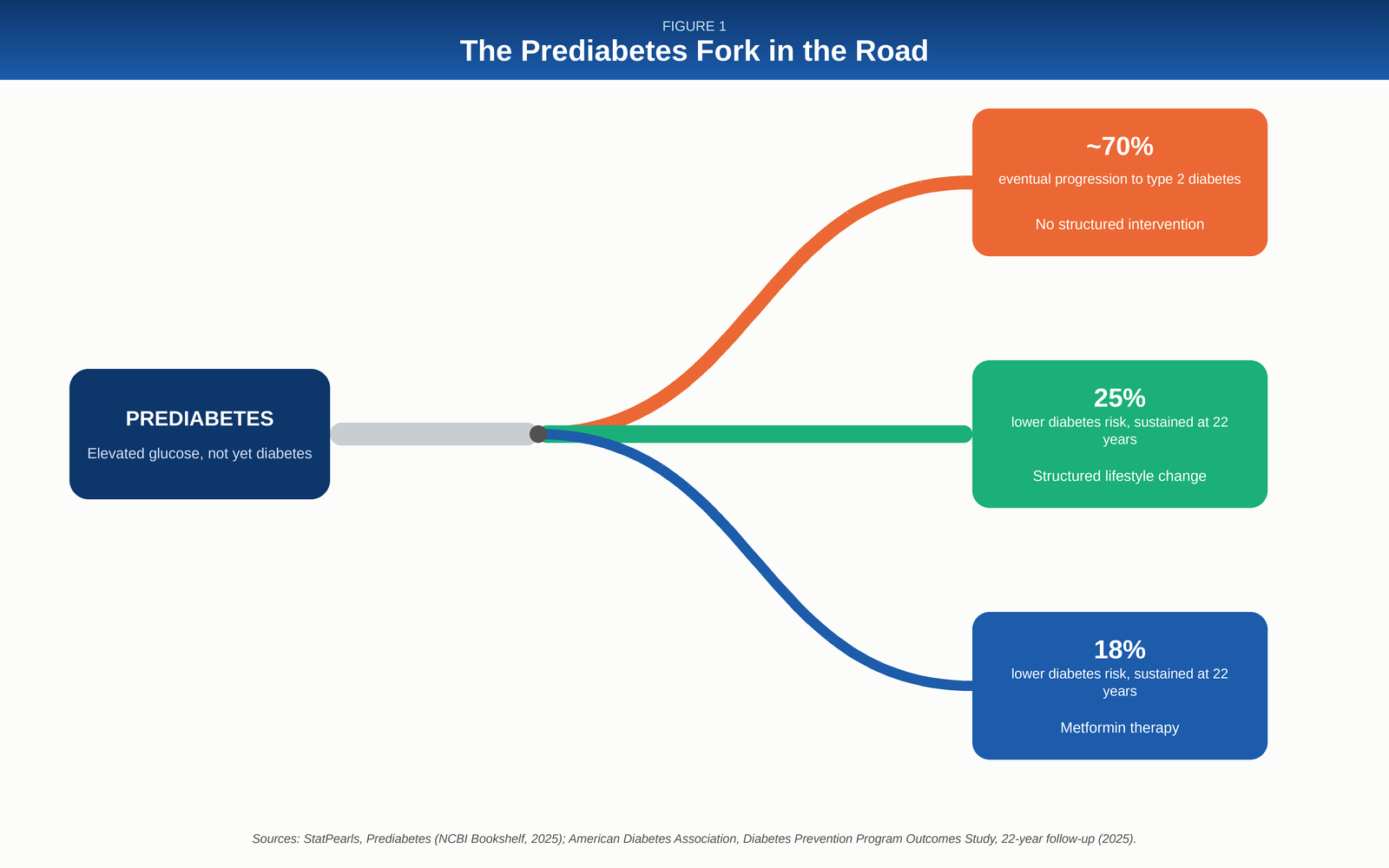
Figure 1. Prediabetes is not a fixed endpoint. Outcomes diverge sharply depending on whether structured intervention follows the diagnosis.
Among adolescents, a 2025 CDC analysis of national survey data found that 32.7% of 12- to 17-year-olds, roughly 8.4 million U.S. teens, met prediabetes criteria based on fasting glucose or A1C testing.[2] That figure is higher than earlier estimates, but part of the increase reflects a change in analytic methodology rather than a near-doubling of true prevalence: when the newer method was applied retrospectively to 2015-2016 data, prevalence for that period was recalculated at 28%, not the roughly 20% originally reported.[2] The underlying trend is still upward, but the size of the jump is smaller than the headline figure alone suggests, and reading the number correctly rather than reflexively matters for anyone using it to plan services or communications.
Why So Many Cases Go Unnoticed
Prediabetes is, for the large majority of people who have it, silent. The symptoms most often associated with high blood sugar, increased thirst, frequent urination, fatigue, and blurred vision, typically signal glucose levels well into the diabetes range rather than the prediabetes range, which is why relying on symptoms to prompt testing misses nearly everyone who currently has the condition.[3][4]
The one physical sign more specifically associated with the insulin resistance that underlies prediabetes is acanthosis nigricans: darkened, thickened, velvety patches of skin, most often at the neck, armpits, or groin. It is more common, and often more visible, in children and adolescents with excess adiposity, and clinicians increasingly treat its presence as a prompt for glucose testing rather than a purely cosmetic finding.[2]
MYTH VS. FACT
Myth: “If something were wrong with my blood sugar, I would feel it.”
Fact: Roughly 8 in 10 adults with prediabetes are unaware of it, precisely because it does not reliably announce itself. A blood test, not a symptom checklist, is what finds it.[1][4]
Prediabetes in Children and Adolescents
Pediatric prediabetes deserves treatment as its own topic rather than a smaller version of the adult condition. The scale is larger than most clinicians outside endocrinology assume, nearly a third of U.S. teenagers by the most recent CDC estimate, and the risk factor profile, while overlapping with the adult picture, has pediatric-specific weight.[2]
Recognized risk factors in youth include a body mass index at or above the 85th percentile for age and sex, a family history of type 2 diabetes, a mother’s history of gestational diabetes, and social determinants such as limited access to affordable healthy food and safe spaces for physical activity, factors that also help explain why prevalence is not distributed evenly across racial and ethnic groups.[2] Professional guidance generally supports screening at-risk youth starting around the onset of puberty or age 10, whichever comes first, rather than waiting for symptoms that, as in adults, usually do not appear.
Left unaddressed, pediatric prediabetes carries the same downstream risk of progression to type 2 diabetes, cardiovascular disease, and metabolic syndrome that adult prediabetes does, compounded by a longer lifetime horizon over which those risks can accumulate. The more encouraging finding from the same CDC analysis is that progression is not the default outcome: an estimated 45% to 75% of adolescents with prediabetes revert to normal glucose measures on follow-up testing, a substantially more optimistic picture than the adult progression data alone would suggest, and a strong argument for early identification paired with realistic, family-centered support rather than alarm.[2]
What the Evidence Actually Supports for Reversal
The most rigorously followed evidence on reversing prediabetes comes from the U.S. Diabetes Prevention Program and its long-running follow-up study, the DPP Outcomes Study. Participants with prediabetes were assigned to an intensive lifestyle intervention, metformin, or placebo, and have now been followed for an average of 22 years, one of the longest intervention follow-ups in metabolic disease research.[5]
Relative to the original placebo group, the lifestyle intervention group had a 25% lower incidence of type 2 diabetes and the metformin group an 18% lower incidence, effects that persisted for two decades rather than fading once the formal study period ended. Among participants in either active arm who avoided developing diabetes, the study also recorded meaningful downstream benefit: 57% lower risk of early diabetic eye disease, 37% lower risk of early kidney disease, and 39% fewer major cardiovascular events.[5]
The specific lifestyle targets behind those numbers are consistent across current clinical guidance: a 5% to 7% reduction in body weight for people who are overweight, at least 150 minutes per week of moderate-intensity physical activity such as brisk walking, and an evidence-based eating pattern, Mediterranean, DASH, or a lower-carbohydrate approach among the options, individualized to the person rather than prescribed as a single template.[6]
Fiber intake specifically has its own, separately substantiated evidence base. A systematic review and meta-analysis pooling 42 controlled trials and 2 large prospective cohorts found that higher fiber intake reduced A1C and fasting glucose, improved cholesterol and body weight, and was associated with a 35% lower risk of all-cause mortality when comparing higher intakes (around 35 grams per day) against lower ones (around 19 grams per day). The authors proposed increasing daily fiber intake by roughly 15 grams, toward a target near 35 grams a day, as a realistic, evidence-supported goal.[8]
Where Nutritional and Nutraceutical Support Responsibly Fits
Nutraceutical formulations have a legitimate, evidence-graded role in supporting glycemic health, but that role is as an adjunct to established lifestyle change and, where indicated, medication, not a substitute for either. The strength of evidence varies meaningfully by ingredient, and a credible product strategy reflects that variation rather than flattening it into uniform marketing language.
Fiber-forward formulations carry the strongest and most consistent evidence of the options discussed here, drawing directly on the meta-analysis referenced above: measurable reductions in A1C and fasting glucose across dozens of controlled trials, plus favorable effects on weight and lipids.[8]
Berberine has a growing but still developing evidence base. A 2025 systematic review and meta-analysis of 12 randomized, placebo-controlled trials in 889 participants found statistically significant reductions in fasting plasma glucose, 2-hour oral glucose tolerance results, triglycerides, and waist circumference, with adverse event rates comparable to placebo, mild gastrointestinal effects (nausea, constipation, abdominal discomfort) were the most commonly reported. The same review noted that most trials were short in duration and geographically concentrated, and called explicitly for larger, higher-quality trials before the evidence could be considered definitive.[7]
Evidence for several other commonly marketed glycemic-support ingredients remains thinner and more mixed than either of the above, a distinction worth preserving in formulation and marketing decisions rather than presenting the category as uniformly well-substantiated.
When Medication Enters the Picture
For adults who do not reach glycemic targets through lifestyle change alone, or who fall into higher-risk categories from the outset, current ADA guidance recommends considering metformin for adults aged 25 to 59 with a BMI of 35 kg/m² or higher, a fasting glucose of 110 mg/dL or higher, an A1C of 6.0% or higher, or a personal history of gestational diabetes. Acarbose is used as an alternative in some patients.[4][6] Periodic monitoring of vitamin B12 is recommended for people on long-term metformin therapy, since the medication can reduce B12 absorption over time.[6]
Medication is a tool for a specific subset of the prediabetes population, not a default first step, and current guidance continues to position it alongside, not instead of, the lifestyle targets described above.
The Global Burden and Why Distribution Reality Matters
Prediabetes is not evenly distributed, and neither is the infrastructure to identify or manage it. Age-standardized rates of impaired glucose tolerance are highest in South-East Asia and lowest in Europe, and prevalence runs higher in middle-income countries (12.3%) than in either high-income (10.4%) or low-income countries (11.6%), a pattern that reflects rapid dietary and lifestyle transition outpacing the buildup of screening and primary-care capacity.[9][10]
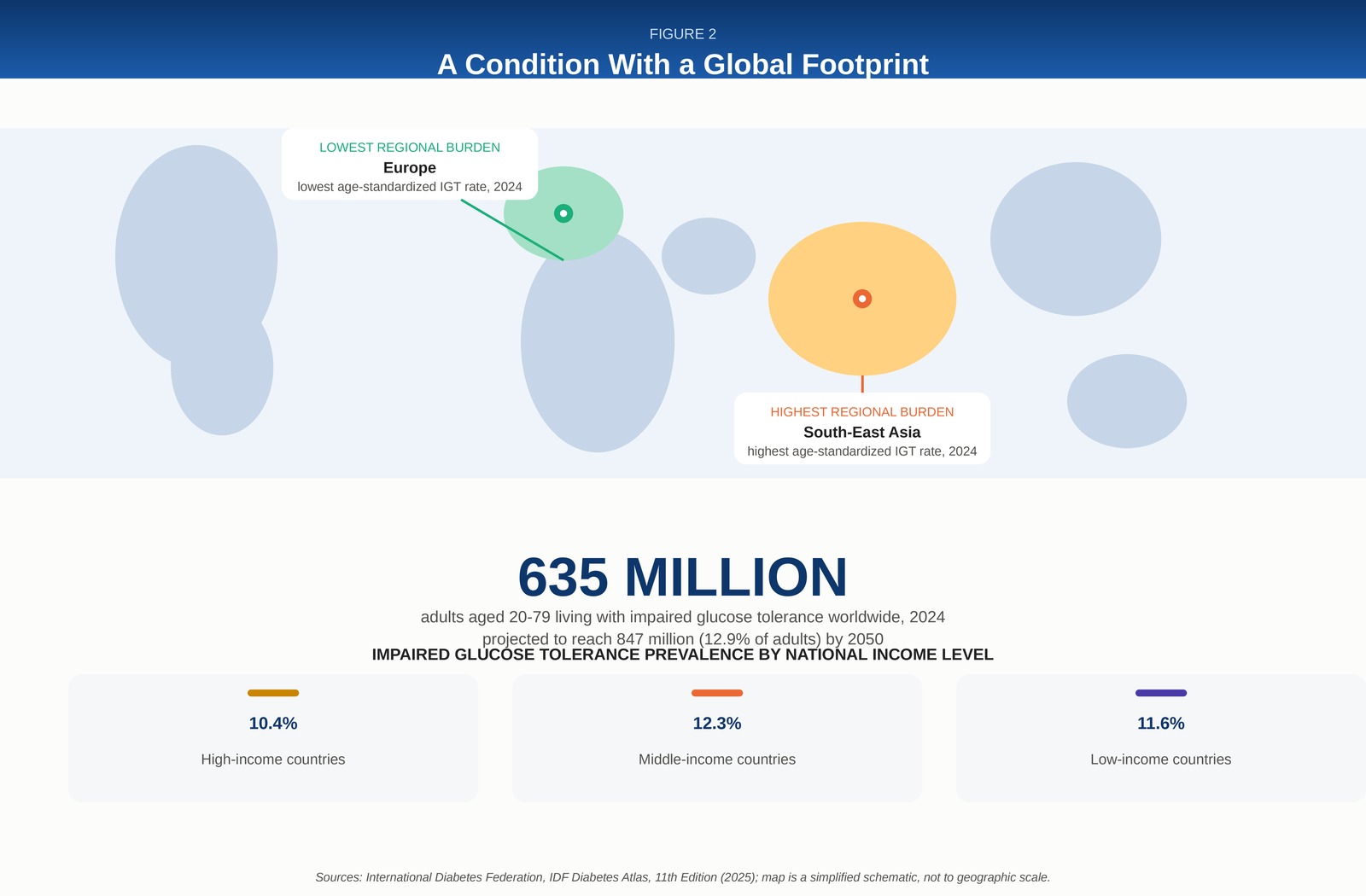
Figure 2. Impaired glucose tolerance is a global condition with an uneven regional footprint, one that tracks closely with where screening infrastructure and evidence-based nutritional support are hardest to access.
For distributors, wholesalers, and pharmacy partners, that unevenness is not an abstraction. It is the practical difference between markets where glycemic-support nutrition is already a mature, well-understood category and markets where the same evidence base is only beginning to reach the clinicians and patients who could act on it. Closing that gap responsibly, with products backed by the kind of graded evidence outlined above, is where the commercial and public-health interest genuinely overlap.
A Practical Checklist for Metabolic Health Partners
✓ Confirm any prediabetes finding against two qualifying results, A1C, fasting glucose, or an oral glucose tolerance test, rather than acting on a single reading.[4]
✓ Screen at-risk children using BMI together with additional risk factors, not weight in isolation, generally from puberty or age 10 onward.[2]
✓ Anchor any recommendation in the 5% to 7% weight loss and 150 minutes per week activity targets before layering on anything else; they remain the best-evidenced intervention available.[5][6]
✓ Position nutraceutical ingredients by their actual evidence tier, fiber first, berberine as a promising but still-developing adjunct, rather than marketing the category as uniform.[7][8]
✓ Reassess regularly. Prediabetes is not a fixed label. Most people carrying it will move toward diabetes or back toward normal glucose within a few years, and which direction is heavily influenced by what happens next.[2][5]
Formulating Metabolic Health Support Across the Prediabetes Continuum
Mevian works with distributors, pharmacy partners, and healthcare professionals to bring nutraceutical and clinical nutrition formulations to market with the evidence behind them clearly represented, not overstated. That includes fiber-forward and glycemic-support formulations positioned honestly against the tiered evidence base described in this overview, and it includes the FSMP and clinical nutrition expertise to support formulation decisions grounded in current guidance rather than category convention.
If your organization is evaluating a glycemic-support portfolio, or looking to bring evidence-graded metabolic health products into markets where screening and nutrition support are still catching up to demand, Mevian’s team is a resource worth involving early in that process.