
For wholesalers and R&D-driven nutraceutical companies, a product portfolio is rarely built by design. It accumulates over years, shaped by shifting consumer trends, one-off client requests, regulatory changes and opportunistic launches. Left unmanaged, that accumulation creates hidden costs: capital tied up in slow-moving stock, R&D effort spread too thinly, and blind spots in categories where competitors are already gaining ground. Structured portfolio management addresses this directly, giving organisations a repeatable framework for deciding what to develop, what to stock and what to retire.
MARKET TRAJECTORY $636.2B → $1.15T Global nutraceuticals market, 2025 → 2033 (7.7% CAGR) |
CONCENTRATION EFFECT ≈ 80 / 20 Share of sales typically driven by a minority of SKUs |
CORE DISCIPLINES 5 Portfolio-management practices covered in this article |
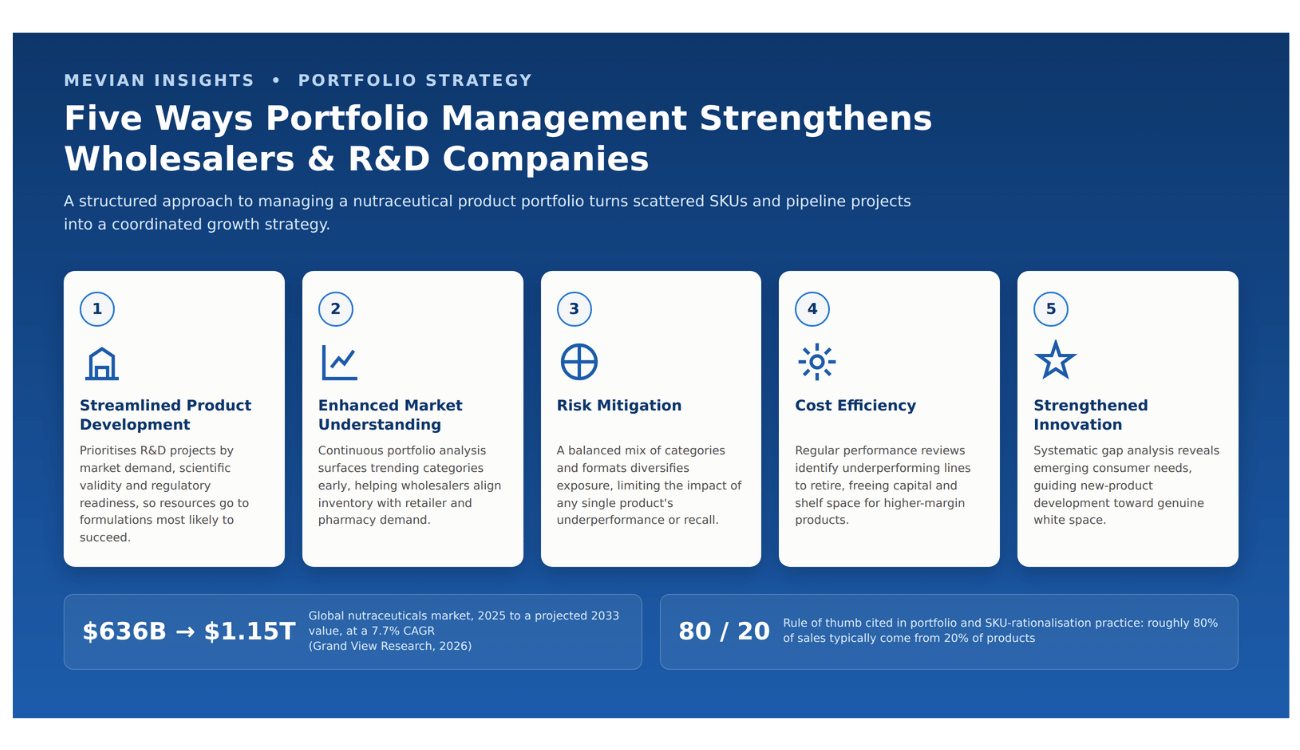
1. Streamlined Product Development
A well-managed portfolio gives R&D teams a clear basis for prioritisation, rather than a first-come, first-served pipeline. Projects are evaluated against three consistent criteria: market demand, scientific validity and regulatory feasibility. This keeps development effort focused on formulations with a realistic path to launch, rather than concepts that stall in the later stages of registration or clinical substantiation — a common and costly failure point in FSMP and functional-food development.
2. Enhanced Market Understanding
Reviewing a portfolio as a whole, rather than product by product, surfaces patterns that are otherwise easy to miss. For wholesalers in particular, ongoing portfolio analysis highlights which categories are gaining traction with retailers and pharmacy partners, allowing inventory and purchasing decisions to shift ahead of demand rather than in reaction to it. This is especially relevant in categories such as immune support, healthy ageing and gut health, where consumer interest can move faster than traditional planning cycles.
3. Risk Mitigation
Concentration risk is one of the most underestimated exposures in the nutraceutical sector. A portfolio weighted too heavily toward a single ingredient, format or regulatory category is vulnerable to supply disruption, adverse regulatory rulings or a single high-profile safety concern. A balanced, deliberately diversified portfolio spreads that exposure across categories, formats and markets, so that a setback in one line does not disproportionately affect the business as a whole.
4. Cost Efficiency
Portfolio management is, in practice, an ongoing exercise in resource reallocation. Regular performance reviews — tracking metrics such as sell-through rate, margin contribution and return frequency — identify which products are consistently underperforming. Discontinuing those lines frees working capital, warehouse space and commercial attention for products with stronger unit economics, rather than allowing legacy SKUs to draw resources indefinitely.
5. Strengthened Innovation
Systematic portfolio evaluation is also an innovation tool. Mapping current offerings against emerging health priorities — from personalised nutrition to condition-specific FSMPs — reveals genuine white space rather than crowded, saturated categories. Organisations that treat portfolio review as a recurring discipline, rather than an annual exercise, are better placed to act on those gaps before competitors do.
Conclusion
Portfolio management is not a one-time restructuring exercise; it is an operating discipline. Companies that review their product mix on a continuing basis are better equipped to allocate R&D investment with confidence, manage risk proactively and adapt as consumer health priorities evolve. In a market projected to nearly double in value by 2033, that discipline is increasingly what separates sustainable growth from opportunistic, short-lived gains.
Next step
Distributors, wholesalers and pharmacy partners evaluating or restructuring a nutraceutical product range can speak with Mevian’s team about portfolio strategy, category gap analysis and international distribution support.