Selenium is one of the smallest-dose essential nutrients the body requires, yet gram for gram it plays an outsized role in a single organ: the thyroid. Of all the tissues in the human body, the thyroid gland holds the highest selenium concentration per gram[1], a biological signal that this trace mineral is not incidental to thyroid physiology but structurally built into it. Selenium is incorporated, via the amino acid selenocysteine, into more than two dozen selenoproteins, several of which directly govern how thyroid hormone is made, activated, and protected from the gland’s own chemistry.
For Mevian’s partners, distributors sourcing raw ingredients, pharmacy teams fielding patient questions, and healthcare professionals interpreting thyroid labs, the practical challenge is separating well-established mechanism from still-developing clinical evidence. This review covers both: how selenium physiologically supports thyroid hormone metabolism, what randomised trials show (and do not yet show) about selenium in autoimmune thyroid disease, and what the balance between deficiency and excess means for formulation, sourcing, and clinical guidance.
Selenium’s Biological Role: Beyond the Thyroid
Selenium’s thyroid-specific functions sit within a broader physiological role. Before narrowing to the thyroid axis, four other well-characterised functions are worth establishing:
- Antioxidant defence. As a catalytic component of the glutathione peroxidase (GPx) family, selenium enables the neutralisation of hydrogen peroxide and lipid hydroperoxides, limiting oxidative damage to cell membranes, proteins, and DNA across tissues[2].
- Immune modulation. Selenium status influences T-cell proliferation and function; in individuals with confirmed deficiency, repletion has been associated with improved markers of both innate and adaptive immune response, though effects in selenium-replete populations are far less pronounced[3].
- Neurological support. Selenoprotein P is the principal selenium-transport protein to the brain, where it contributes to neuronal antioxidant defence. Research into selenium’s relationship with cognitive ageing and neurodegenerative risk is active but still emerging, and findings should be treated as hypothesis-generating rather than conclusive[4].
- Reproductive physiology. Selenium is required for normal sperm structure and motility in men and contributes to oocyte and placental antioxidant defence in women, reflecting its broader role in cells with high metabolic and oxidative demand[5].
The Selenium-Thyroid Axis: How the Two Are Linked
The thyroid’s dependence on selenium follows directly from how thyroid hormone is made and activated. Thyroid peroxidase, the enzyme that assembles thyroid hormone within the follicular cells, generates hydrogen peroxide as a working byproduct of that synthesis. Left unchecked, this would damage the very cells producing the hormone. Selenium-dependent glutathione peroxidases neutralise this self-generated oxidative load, meaning the thyroid gland requires selenium simply to protect itself from its own hormone-making machinery[1].
Selenium’s second and more widely recognised role is activation. Thyroxine (T4), the hormone the thyroid secretes in the largest quantity, is largely inactive until converted to triiodothyronine (T3), the form that binds nuclear thyroid hormone receptors and drives metabolic effects. That conversion is carried out by a family of selenium-dependent iodothyronine deiodinases: DIO1 and DIO2 remove a single iodine atom from T4 to yield active T3, while DIO3 inactivates T3 and T4 to reverse T3, providing a regulatory brake. Selenium deficiency has been shown to impair this conversion, and human studies measuring the T3-to-T4 ratio have found it correlates with selenium status, particularly in older adults[6].
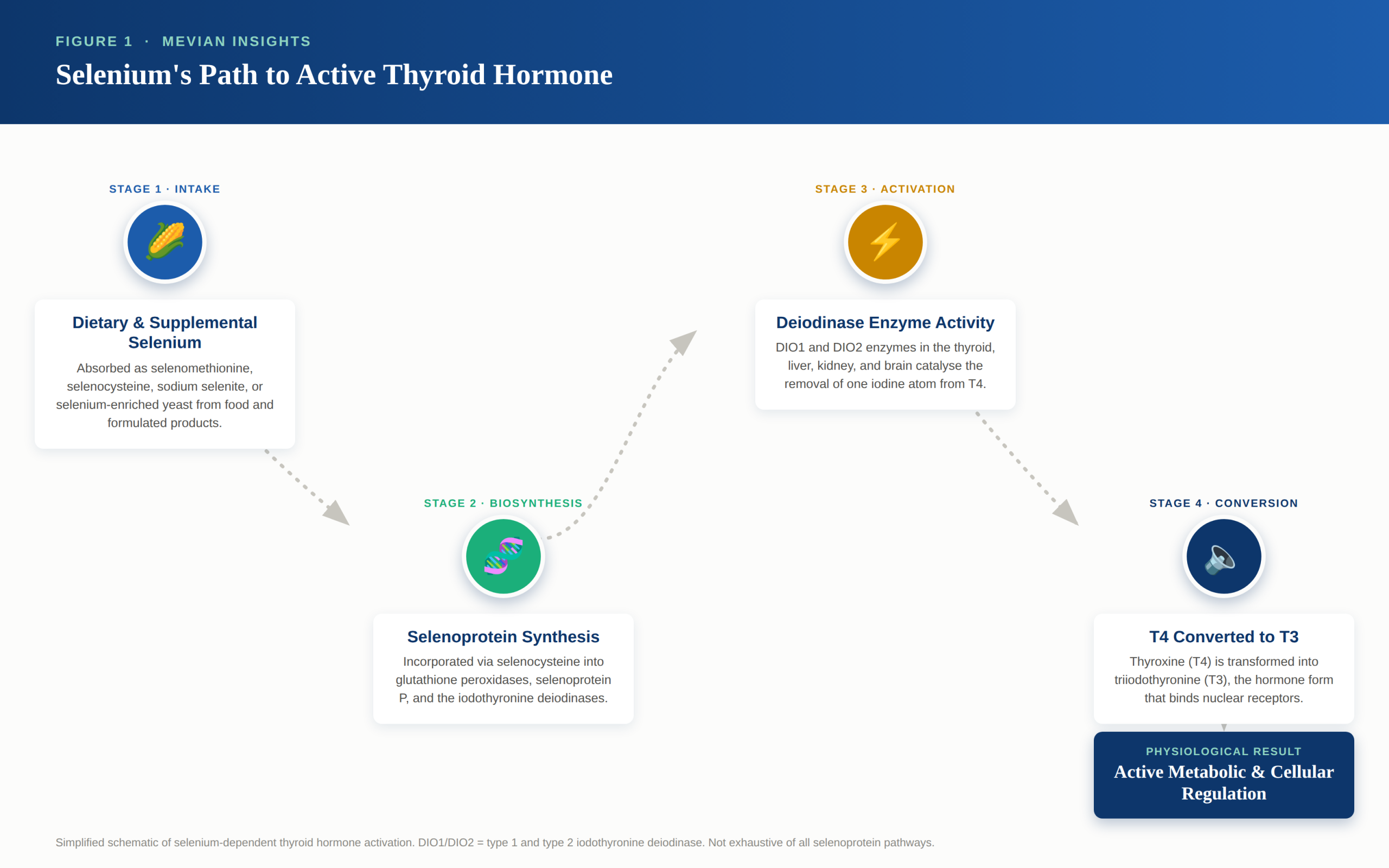
Figure 1. Selenium-dependent selenoproteins govern both the activation of thyroid hormone and the thyroid gland’s protection from oxidative byproducts of its own hormone synthesis.
Selenium does not act alone. Because deiodinase activity depends on selenium while thyroid hormone synthesis itself depends on iodine, the two minerals function as a coupled system rather than independent variables. Early observational research in regions with combined iodine and selenium deficiency suggested that correcting iodine intake without adequate selenium status could, in some contexts, aggravate rather than resolve thyroid dysfunction, a finding that continues to inform why nutrition strategies for thyroid support are generally designed around both minerals together, not selenium in isolation[7].
Selenium, Autoimmune Thyroid Disease, and the Clinical Evidence
In iodine-sufficient regions, autoimmune conditions, chiefly Hashimoto’s thyroiditis and Graves’ disease, are the leading cause of thyroid dysfunction. Selenium status has been studied as a potential adjunctive factor in both, and the evidence base, while genuinely informative, is more qualified than popular summaries often suggest.
Hashimoto’s Thyroiditis
An early meta-analysis found that selenium supplementation was associated with significantly lower thyroid peroxidase antibody (TPOAb) titres at three months compared with placebo, alongside a markedly higher likelihood of self-reported improvement in mood and general well-being (risk ratio approximately 2.8)[8]. A 2025 systematic review reported a similar direction of effect, with moderate-to-large reductions in TPOAb at three and six months, more pronounced in patients not concurrently treated with levothyroxine, but rated the certainty of this evidence as very low[9].
The most comprehensive assessment to date, an overview of six systematic reviews spanning 75 randomised trials, pooled 23 non-overlapping RCTs covering 2,292 patients. Only one of the six underlying reviews met high-quality standards under AMSTAR-2 criteria. Its conclusion is a useful corrective to overstated claims: despite consistent short-term antibody reductions, routine selenium supplementation for Hashimoto’s thyroiditis is not currently recommended on the strength of available evidence, though the safety profile is favourable, with mild gastrointestinal discomfort the most commonly reported adverse effect and no serious safety signals identified[10].
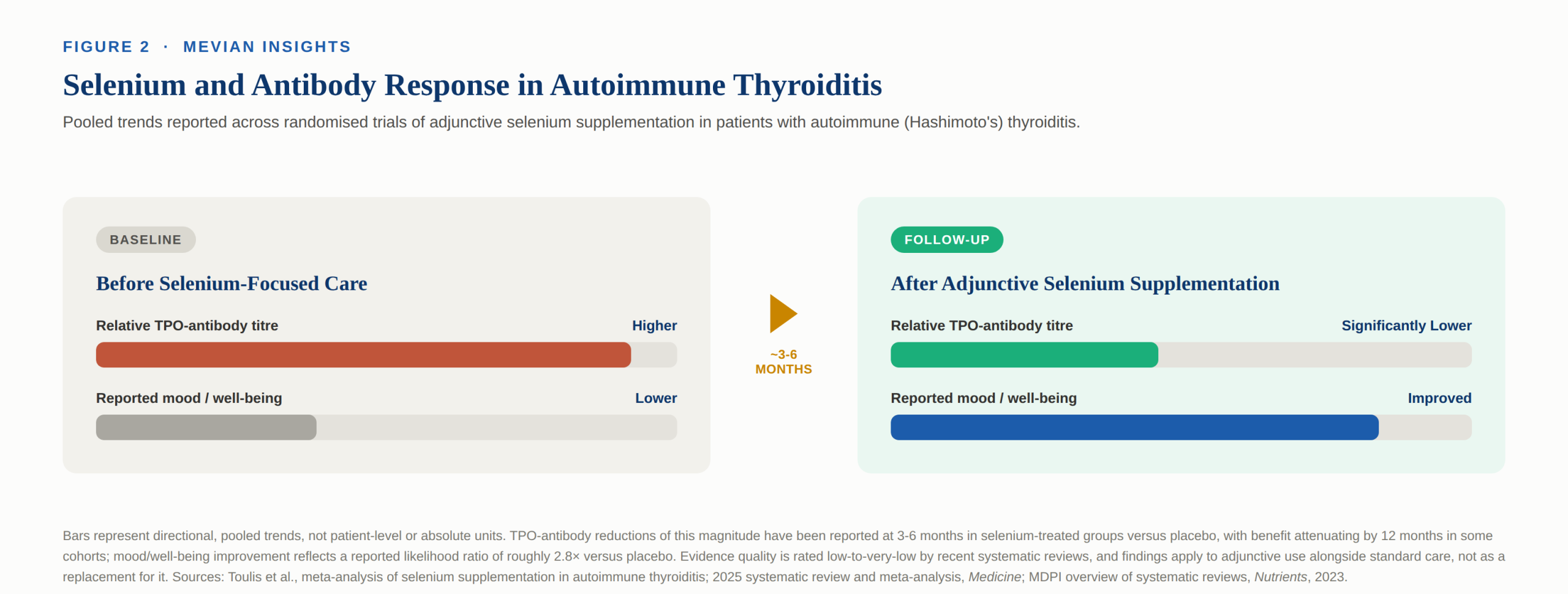
Figure 2. Directional trends reported across randomised trials of adjunctive selenium supplementation in autoimmune thyroiditis. Evidence certainty is rated low to very low; figures are pooled trends, not absolute or patient-level values.
Graves’ Orbitopathy
The strongest randomised evidence for selenium in autoimmune thyroid disease relates specifically to mild Graves’ orbitopathy, the eye involvement that can accompany Graves’ disease. In a landmark European trial of 152 patients, six months of sodium selenite (100 micrograms twice daily) significantly reduced the proportion of patients whose quality of life worsened (17% versus 43% with placebo) and improved eyelid aperture and soft-tissue involvement, with benefits still present at twelve-month follow-up[11]. More recent five-year cohort data and a 2025 trial conducted specifically in a selenium-sufficient population have added useful nuance, suggesting the magnitude of benefit may depend on a population’s baseline selenium status, reinforcing that these findings do not automatically generalise to every patient group or geography[12].
Across both conditions, the responsible clinical framing is consistent: selenium is best understood as a supervised adjunct to standard care, never a substitute for it. Standard care includes levothyroxine, antithyroid medication, and appropriate endocrinology follow-up.
Deficiency, Excess, and the Importance of Balance
The U.S. and Canadian Dietary Reference Intakes set the Recommended Dietary Allowance for selenium at 55 micrograms per day for adults, rising to 60 micrograms during pregnancy and 70 micrograms during lactation. The Tolerable Upper Intake Level is 400 micrograms per day[13], roughly seven times the RDA, a narrower safety margin than many other essential trace minerals, which makes dosing precision a genuine formulation consideration rather than a formality.
Selenium content in food depends almost entirely on the selenium concentration of the soil in which it was grown or grazed, which varies enormously by geography. Current estimates suggest that up to one billion people globally have selenium-insufficient diets, with soils in parts of China, India, southern Africa, the southwestern United States, southern South America, and several European countries, including Germany, Denmark, Scotland, Finland, and parts of the Balkans, naturally low in selenium[14]. Modelling published in the Proceedings of the National Academy of Sciences projects that under a moderate climate-change scenario, roughly two-thirds of global cropland could see further selenium decline, averaging close to a 9% reduction, by the end of the century, driven primarily by shifting precipitation and aridity patterns[14].
The clearest historical illustration of severe deficiency is Keshan disease, a form of congestive cardiomyopathy first documented in selenium-poor regions of China in the 1930s, disproportionately affecting children and women of childbearing age with mortality historically reaching 50% in affected populations. Selenium fortification of table salt in endemic regions has since substantially reduced its incidence[15], a reminder that, while rare in well-nourished populations today, selenium deficiency is a documented and serious clinical entity, not a theoretical concern.
Excess intake carries its own risks. Selenosis, chronic selenium toxicity, presents with hair and nail brittleness or loss, gastrointestinal symptoms, skin changes, a garlic-like breath odour, and, at high doses, neurological effects. Some epidemiological research has also observed a U-shaped relationship between selenium intake and certain long-term health outcomes, meaning both insufficient and excessive intake carry risk, a finding that argues against a more-is-better approach to selenium supplementation[16].
What This Means for Formulators, Distributors, and Care Teams
The mechanism and evidence above translate into several concrete considerations for Mevian’s professional audience:
- Form selection matters. Comparative absorption research consistently shows organic selenium sources, selenomethionine, typically derived from selenium-enriched yeast, are retained in tissue substantially longer than inorganic sodium selenite, which clears rapidly once supplementation stops[17]. Note, however, that landmark clinical trials such as the Graves’ orbitopathy study specifically used sodium selenite, a reminder to match the evidence base to the actual formulation, not to assume interchangeability between selenium forms.
- Sourcing and quality control. Because selenium content in raw agricultural and yeast-based ingredients tracks soil origin, batch-to-batch variability is a genuine analytical concern. Verified sourcing and third-party content testing are particularly important for FSMPs and other products where label-claim accuracy carries regulatory weight.
- Consider the iodine relationship. Given the coupled physiology described above, thyroid-support formulations are generally better designed with iodine status in mind rather than treating selenium as a standalone ingredient.
- Respect the narrow dosing margin. With the Tolerable Upper Intake Level only around seven times the RDA, clear label guidance and conservative dosing are more consequential for selenium than for many other trace minerals.
- Keep claims proportionate to evidence tier. Mechanistic and observational evidence for selenium’s role in thyroid hormone metabolism is strong; evidence for supplementation as a treatment for autoimmune thyroid disease is still rated low-certainty by systematic reviewers. Regulatory-compliant, nutrition-focused claims language should reflect that distinction rather than blur it.
- Selenium testing is selective, not routine. Most clinical guidelines do not include selenium status in standard thyroid work-ups; testing (serum selenium or selenoprotein P) is generally reserved for patients with restrictive diets, malabsorptive conditions, long-term parenteral nutrition, or residence in known low-selenium regions, useful context for pharmacy partners and care teams fielding patient questions.
Clinical Snapshot: Key Points at a Glance
- Selenium-dependent deiodinase enzymes convert inactive T4 into active T3, and the thyroid holds the highest tissue selenium concentration of any organ in the body.
- Adjunctive selenium has reduced TPO-antibody titres in Hashimoto’s thyroiditis trials, but evidence certainty is rated low to very low; most current reviews do not recommend routine use.
- The strongest randomised-trial evidence relates to mild Graves’ orbitopathy, using supervised sodium selenite alongside standard care, not as a replacement for it.
- Deficiency risk is geographically concentrated and tied to soil selenium levels; up to an estimated one billion people worldwide have insufficient intake, a risk that climate modelling suggests may grow.
- The RDA (55 µg/day) and Tolerable Upper Intake Level (400 µg/day) sit closer together than for many nutrients, so precise dosing and verified sourcing are not optional details in formulation.
Partner With Mevian
Mevian works with distributors, wholesalers, and pharmacy partners to bring evidence-aligned nutraceutical and FSMP formulations to market, including trace-mineral products built around the kind of mechanistic and clinical nuance outlined above. To discuss selenium sourcing, formulation support, or our broader clinical nutrition portfolio, reach out to the Mevian team.