Cardiovascular disease and stroke remain the world’s leading causes of death and long-term disability, together accounting for roughly one in three deaths worldwide. In 2021, cardiovascular disease was responsible for an estimated 19.4 million deaths globally, and stroke alone accounted for approximately 7.25 million of those deaths — split between ischemic stroke (3.59 million), intracerebral hemorrhage (3.31 million), and subarachnoid hemorrhage (350,000) [1]. Despite these staggering figures, outcomes for both conditions are highly time-sensitive: the interval between symptom onset and treatment is often the single greatest determinant of whether a patient survives, and with what degree of function.
For clinicians, allied health staff, and health-conscious organizations alike, reinforcing accurate, up-to-date symptom recognition is one of the most cost-effective interventions available. This overview summarizes the current evidence on how heart attacks and strokes present, why they differ physiologically, and what the latest guidelines say about the response window that gives patients the best chance of recovery.
Why Minutes Matter: “Time Is Muscle, Time Is Brain”
Both a heart attack and a stroke are caused by an interruption of blood flow to a vital organ. In a heart attack (myocardial infarction), a blocked coronary artery starves part of the heart muscle of oxygen; in an ischemic stroke, a clot blocks blood flow to part of the brain. In both cases, tissue begins to die within minutes, and the damage accumulates the longer flow is interrupted. Every minute of delay in a large-vessel ischemic stroke is estimated to cost the average patient roughly 1.9 million neurons — the basis for the well-known clinical phrase “time is brain.” The same urgency applies to myocardial tissue, which is why professional guidelines frame both conditions as time-critical emergencies rather than symptoms to “wait out.”
Heart Attack: Recognizing the Warning Signs
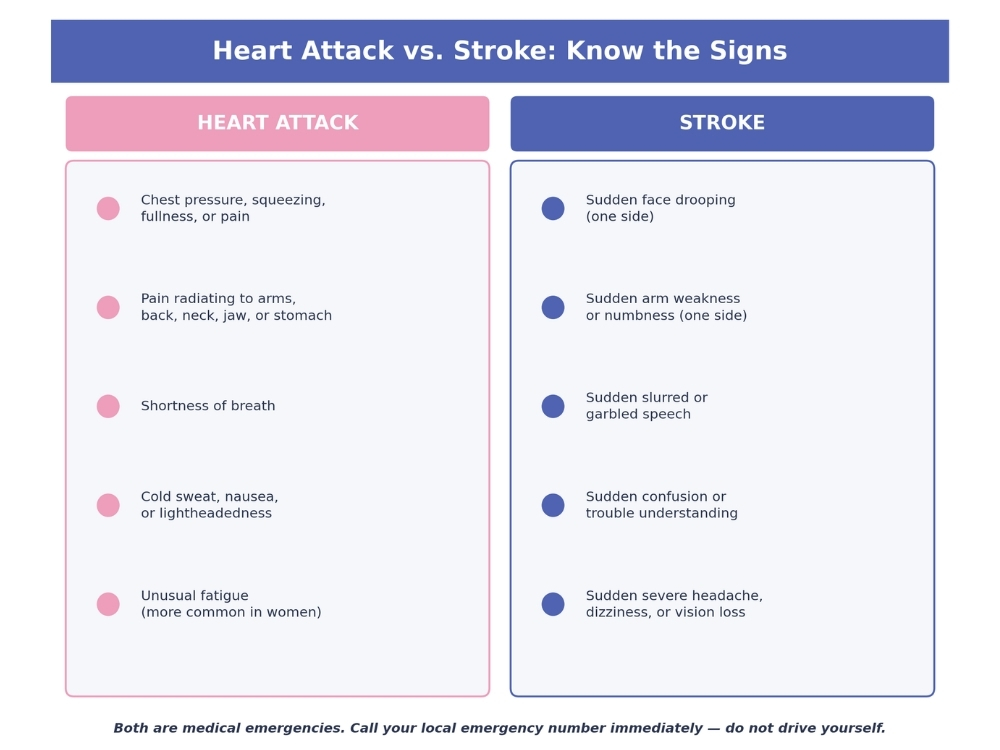
Heart attack symptoms vary from person to person and can begin suddenly or build gradually over minutes to hours. According to the American Heart Association, the most frequently reported signs include [2]:
- Chest discomfort. Pressure, squeezing, fullness, or pain in the center or left side of the chest, lasting more than a few minutes or subsiding and returning.
- Discomfort in other areas of the upper body. Pain or discomfort radiating to one or both arms, the back, neck, jaw, or upper stomach.
- Shortness of breath. May occur with or without chest discomfort, and can appear at rest or during exertion.
- Cold sweat, nausea, or lightheadedness. Autonomic symptoms that often accompany reduced cardiac output.
- Unusual fatigue. Especially relevant in women, who may notice extreme tiredness or sleep disturbance in the days or weeks preceding an event.
Symptom presentation also differs by sex. Women are more likely than men to experience a heart attack without prominent chest pain, instead reporting jaw, neck, or upper-back discomfort, indigestion-like symptoms, or breathlessness — presentations that are more easily misattributed to less serious causes [3]. A related and clinically important phenomenon is the “silent” heart attack: an event with minimal or unrecognized symptoms, sometimes identified only later via ECG or imaging. Silent myocardial infarctions are more common in women and in people with diabetes, and still carry the same long-term risk of heart failure and recurrent events as a recognized heart attack [3].
Stroke: Recognizing the Warning Signs
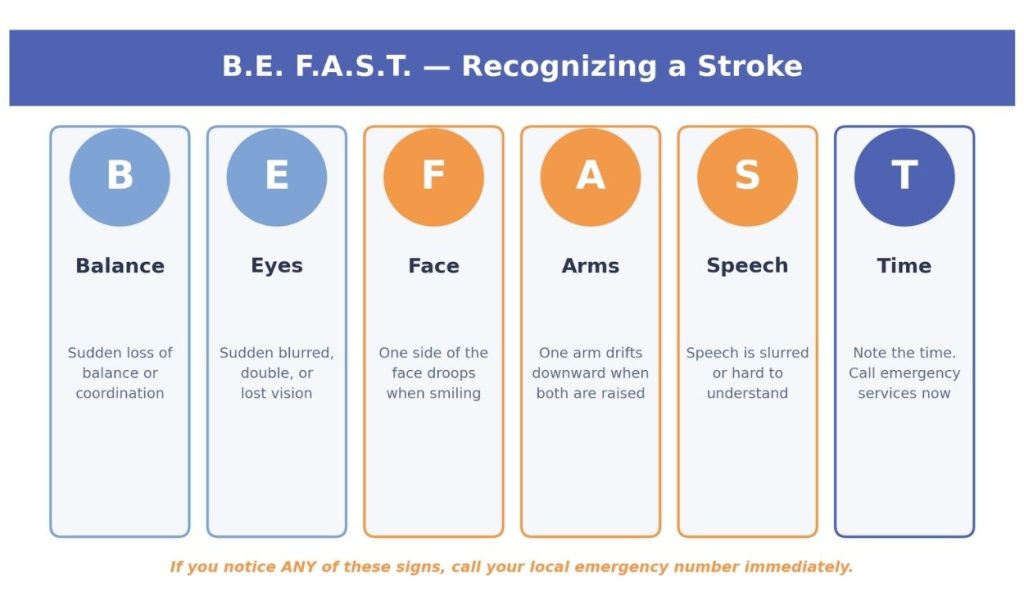
Stroke symptoms are typically sudden in onset and, unlike many heart attacks, are rarely accompanied by pain. The U.S. Centers for Disease Control and Prevention and the National Institute of Neurological Disorders and Stroke recommend the B.E. F.A.S.T. mnemonic as a fast bedside or lay-public screening tool [4][5]:
- Sudden loss of balance or coordination.
- Sudden blurred, double, or lost vision in one or both eyes.
- One side of the face droops or feels numb; ask the person to smile and check for asymmetry.
- One arm is weak or numb; ask the person to raise both arms and watch for downward drift.
- Speech is slurred, garbled, or the person struggles to repeat a simple sentence.
- If any of the above are present, note the time symptoms began and call emergency services immediately.
Additional warning signs include sudden severe headache with no known cause (which can indicate a hemorrhagic stroke), sudden confusion or difficulty understanding speech, and sudden trouble walking or dizziness [4][5]. Because stroke symptoms are painless and can resolve temporarily — as in a transient ischemic attack, or TIA — they are frequently ignored or explained away. A TIA is a medical emergency in its own right: it signals a substantially elevated short-term risk of a full stroke and warrants the same urgency as persistent symptoms.
What Happens in the Body
A heart attack occurs when a coronary artery is blocked — most often by a ruptured atherosclerotic plaque and the clot it triggers — cutting off oxygen to the heart muscle it supplies. Untreated, this can progress to arrhythmia, heart failure, or cardiac arrest. Stroke is broadly divided into two types with very different treatment pathways: ischemic stroke, caused by a clot blocking a cerebral artery, accounts for the majority of cases and the largest share of stroke deaths worldwide; hemorrhagic stroke, caused by a ruptured blood vessel bleeding into or around the brain, is less common but carries a higher case-fatality rate [1]. Distinguishing between the two requires brain imaging, which is why emergency transport — rather than self-diagnosis or home treatment — is essential in every suspected case.
Responding in the First Minutes
For both conditions, the single most important action is to call emergency services immediately rather than waiting to see if symptoms pass, arranging private transport, or contacting a physician’s office first. Emergency medical services can begin treatment, transmit diagnostic information ahead of arrival, and route the patient to a facility equipped for cardiac catheterization or stroke thrombectomy.
Aspirin guidance has been refined in recent years. Current American Heart Association and Red Cross first aid guidelines note that a conscious adult with non-traumatic chest pain and no known aspirin allergy may be advised to chew a 162–325 mg dose of aspirin — but this should generally be done on the direction of an emergency dispatcher or clinician, not decided independently by a bystander, since chest pain can occasionally stem from conditions (such as aortic dissection) that aspirin can worsen [6]. Aspirin has no role in suspected stroke and should not be given, since it can increase bleeding in the roughly one in five strokes that are hemorrhagic.
Treatment Windows and Options
Time-sensitive interventions define modern treatment for both conditions.
- Heart attack. Options include antiplatelet and anticoagulant medications, percutaneous coronary intervention (angioplasty with stenting) to reopen the blocked artery, and coronary artery bypass grafting for more extensive disease. Door-to-balloon time — the interval from hospital arrival to artery reopening — remains a key quality benchmark in cardiac care.
- Ischemic stroke. Intravenous thrombolysis (alteplase or tenecteplase) is the guideline-standard treatment within 4.5 hours of symptom onset. Mechanical thrombectomy — physical removal of the clot via catheter — is standard within roughly 6 to 24 hours for eligible large-vessel occlusions selected using perfusion imaging. Emerging trial evidence is exploring thrombolysis beyond the traditional 4.5-hour mark in carefully imaged patients, though this has not yet been adopted as a formal Class I recommendation in most national guidelines [7][8].
- Hemorrhagic stroke. Management focuses on controlling bleeding and intracranial pressure, and may require surgical intervention to repair the vessel or evacuate the hematoma.
In every case, treatment eligibility is time-limited, which is why recognizing symptoms early and activating emergency care without delay directly shapes the range of options available to the treating team.
Modifiable Risk Factors
Most cardiovascular and cerebrovascular events are linked to a small set of modifiable risk factors. Global Burden of Disease analysis attributes an estimated 10.85 million cardiovascular deaths in 2021 to elevated systolic blood pressure, 3.65 million to high LDL cholesterol, and 3.71 million to high body mass index — the last of which rose by 42.8% compared with 2010 [1]. Other well-established contributors include diabetes, tobacco use, physical inactivity, an unbalanced diet, excess alcohol intake, and chronic stress. Addressing these factors through routine screening, patient education, and evidence-based lifestyle and medical management remains the most effective long-term strategy for reducing both incidence and recurrence.
Key Takeaways • Heart attack and stroke together contribute to roughly one in three deaths worldwide; both are time-critical emergencies, not conditions to “wait out.” • Classic heart attack signs include chest pressure, radiating arm/jaw/back pain, shortness of breath, cold sweat, and nausea — women more often present atypically, with fatigue, indigestion-like symptoms, or no chest pain at all. • The B.E. F.A.S.T. mnemonic (Balance, Eyes, Face, Arms, Speech, Time) captures the core stroke warning signs; symptoms are usually sudden and painless. • Call emergency services immediately for any suspected heart attack or stroke. Aspirin may help in a suspected heart attack but only on professional guidance, and should never be given for suspected stroke. • Treatment options — thrombolysis, thrombectomy, angioplasty, bypass surgery — are strictly time-limited, making early recognition and rapid transport the strongest predictors of a good outcome. • Hypertension, high LDL cholesterol, and elevated BMI are the largest modifiable contributors to global cardiovascular mortality and remain the highest-yield targets for prevention. |