Innovation is no longer optional in the sector: new ingredient combinations, delivery formats and positioning strategies launch every quarter, and rapid category growth has attracted an equally rapid pace of imitation. For wholesalers, distributors and R&D-driven manufacturers, that combination of growth and crowding creates a specific strategic problem — how to build products that are genuinely differentiated, rather than incrementally different, in a market where most competitors can copy a formulation faster than they can substantiate one.
Clinical Substantiation: From Nice-to-Have to Market-Entry Requirement
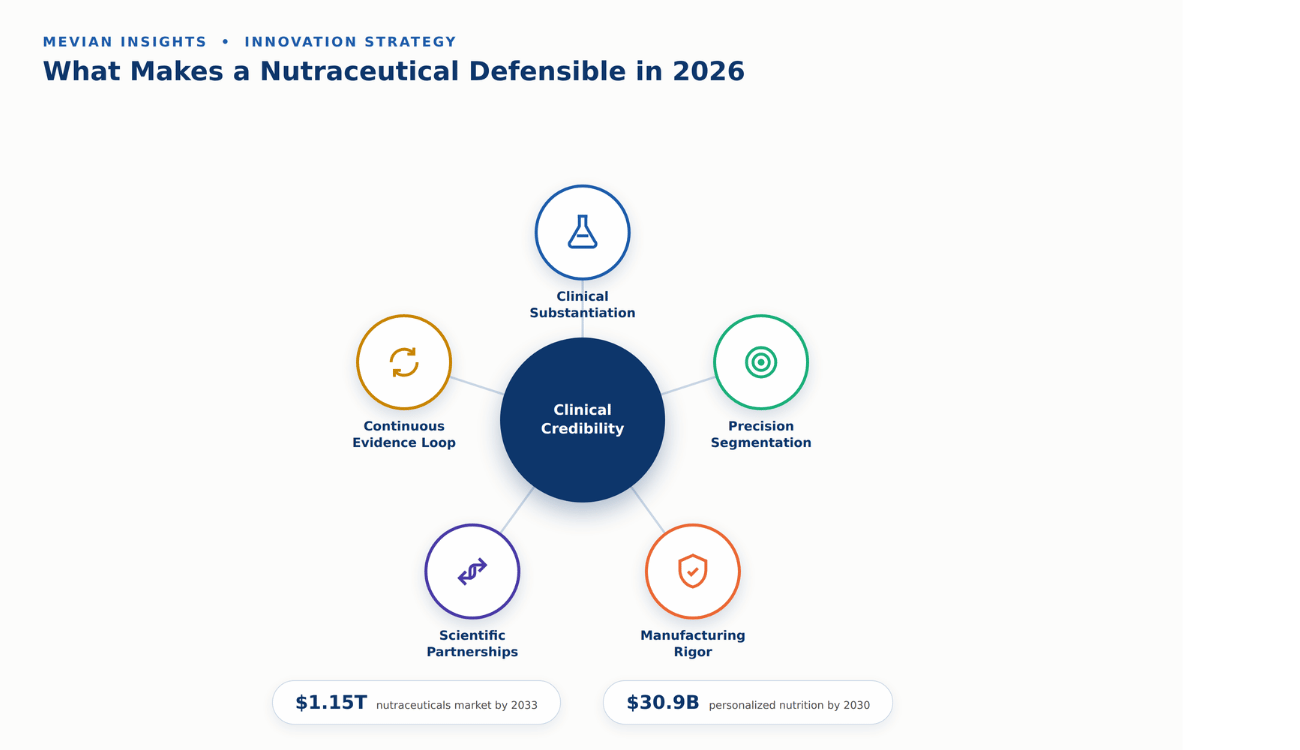
For much of the past decade, being first to market with a novel ingredient was itself a competitive advantage. That advantage has eroded: evidence-based formulation has shifted from a differentiator to a baseline expectation across the sector [1]. Despite that shift, actual investment in clinical evidence remains uneven – a significant share of the market still relies on ingredients supported mainly by bibliographic references, studies conducted on a similar compound and cited as though they validate the finished formulation, rather than direct clinical testing of the product itself [2]. Ingredient manufacturers have moved fastest to close this gap; finished-product brands still lag in both the volume and quality of clinical substantiation behind their own formulations [2]. That gap is a specific, available opportunity for companies willing to invest in direct, product-level evidence.
$1.15 trillion is the value analysts expect the global nutraceuticals market to reach by 2033, up from roughly $636 billion in 2025. (Grand View Research, 2026) [3]
Precision Segmentation: Formulating for Provable Efficacy
Broad-population formulation is losing ground to segment-specific development. Rather than positioning a single formula for general wellness, leading developers are building for defined life stages, health conditions or physiological states – prenatal nutrition, healthy ageing, active recovery, specific micronutrient needs – where efficacy can be measured against a clearer endpoint. This segmentation approach also aligns naturally with FSMP development, where a formulation must already be justified against a defined nutritional need. It is also where the durable growth is: personalised nutrition, built almost entirely on segment-specific claims, is projected to grow from roughly $15.8 billion in 2025 to $30.9 billion by 2030 [4], a trajectory sustained by accumulating clinical research rather than a single viral trend.
Attribute | Commodity Approach | Clinically Positioned Approach |
Evidence base | Bibliographic reference to a similar ingredient | Direct clinical data on the finished formulation |
Target population | Broad, general-wellness claims | Defined life stage, condition or physiological need |
Manufacturing standard | Minimum compliance, ad hoc checks | GMP-grade systems, traceable batch documentation |
Competitive lever | Price and packaging | Substantiated claims and research partnerships |
Post-launch practice | Reformulate only on complaints | Continuous monitoring feeds iterative improvement |
Scientific Partnerships That Compound Credibility
Few organisations can build deep expertise across ingredient science, clinical trial design, regulatory affairs and manufacturing simultaneously. Structured partnerships with universities, contract research organisations, ingredient innovators and specialised co-manufacturers, allow companies to access that expertise without building every capability internally. A credible academic or clinical research partner also lends third-party validation to a finished product’s evidence base, which matters increasingly to pharmacy and healthcare-channel buyers evaluating a new supplier.
Manufacturing Rigor as a Trust Signal
The operational line between pharmaceutical and nutraceutical manufacturing continues to narrow [1]. GMP compliance, batch-level quality control and traceable supply chains are increasingly treated as baseline requirements rather than points of differentiation, and their absence is now a fast way to lose distribution and pharmacy-channel trust, not just a compliance risk. For wholesalers and distributors evaluating new manufacturing partners, documented quality systems and regulatory track record are now as commercially relevant as the formulation itself.
Treating Innovation as a Continuous Loop, Not a Launch Event
Innovation does not end at launch. Post-launch performance, sell-through data, practitioner and pharmacy feedback, adverse-event monitoring, and re-assessment against emerging research, should feed directly back into formulation and portfolio decisions. Organisations that build this feedback loop systematically, rather than reactively, catch underperformance and emerging science early enough to act on it. This continuous review is closely related to disciplined portfolio management, covered in more depth in Mevian’s article on portfolio strategy for wholesalers and R&D companies.
Key Takeaways
- Evidence-based formulation has moved from a competitive edge to a baseline expectation; differentiation now depends on what companies do beyond it.
- Finished-product brands generally lag ingredient manufacturers in direct clinical investment, closing that gap is a concrete, available opportunity.
- Segment-specific formulation makes efficacy easier to prove and claims easier to defend than broad, general-wellness positioning.
- Manufacturing rigor and scientific partnerships function as trust signals in their own right, particularly with pharmacy and healthcare-channel buyers.
- Innovation should operate as a continuous loop, post-launch data and emerging research feeding back into formulation and portfolio decisions, not a one-time launch event.
Frequently Asked Questions
What does it mean for a nutraceutical to be “clinically positioned”?
A clinically positioned nutraceutical is formulated and marketed around direct, product-level evidence, ideally a controlled trial on the finished formulation itself, rather than general references to research on a similar ingredient. It typically targets a defined population or health goal, which makes the evidence easier to generate and the resulting claims easier to defend.
Is clinical substantiation legally required for nutraceuticals?
Requirements vary significantly by product category, ingredient and market, a general wellness supplement, an FSMP and a medical nutrition product each carry different substantiation obligations. Even where direct clinical evidence is not strictly mandated, it is increasingly expected by pharmacy, healthcare-channel and B2B buyers. Companies should confirm their specific obligations with qualified regulatory counsel in each target market.
How can a wholesaler evaluate whether a supplier’s clinical claims are credible?
Ask whether the trial was conducted on the actual finished formulation rather than an individual ingredient, check the sample size and study design (randomized, controlled and, ideally, peer-reviewed), and confirm the manufacturing facility’s GMP status and quality certifications. A credible supplier should be able to share trial documentation directly, not just marketing summaries.
Talk to Mevian
Manufacturers and R&D teams evaluating how to strengthen the clinical and regulatory foundation of a new or existing nutraceutical range can speak with Mevian’s team about formulation development, quality systems and international market entry support.