Two capsules can contain the exact same dose of the exact same ingredient, manufactured on the same production line, packaged in nearly identical bottles. One sells for three times the price of the other, and outsells it. The difference is rarely the formula. It is what each brand can prove about it.
Nutraceutical buyers, from individual consumers to hospital formulary committees to the wholesalers and pharmacy groups deciding what reaches the shelf, are operating in one of the most crowded product categories in consumer health. Global nutraceutical sales are projected to grow from roughly $636.2 billion in 2025 to more than $1.15 trillion by 2033 [1], and a large share of that growth is arriving as new SKUs rather than new categories. In the United States alone, more than 85,000 dietary supplement products compete for attention on the same shelves and the same search results [2]. In a market this saturated, an ingredient list and a persuasive label are no longer enough to justify a premium price or a place in a distributor’s catalogue.
Clinical research has become the industry’s primary mechanism for sorting credible products from the rest. But “backed by clinical research” is not one fixed claim. It can mean a rigorously designed, adequately powered randomized controlled trial published in a peer-reviewed journal, or it can mean a single small pilot study, an in-vitro assay, or a mechanistic finding borrowed from a related ingredient. The commercial value a study creates depends almost entirely on which of these it actually is, and that distinction is what this article works through in detail.
WORKING DEFINITION
In this article, “clinical evidence” refers to research conducted in human subjects, under an approved protocol, using the same dose and form found in the finished product. It is distinct from preclinical research, in-vitro or animal studies, which can support a mechanism of action but cannot, on its own, substantiate a claim about how a product performs in people [3][4].
A Market Too Crowded to Win on Claims Alone
The shift shows up directly in what buyers say they will pay. In consumer research on immune-health products by FMCG Gurus, 82% of respondents said they preferred products carrying a clinically proven claim [5]. A separate FrieslandCampina survey of stress-support supplement users found 84% would pay a premium for a product with clinically substantiated claims over an equivalent product without them [5]. A willingness-to-pay study among Malaysian consumers found buyers would pay roughly $100 more for a supplement demonstrating “scientific proof of clear effectiveness,” and $221 more for one with a well-documented safety profile [2].
These preferences translate into measurable commercial outcomes. Haleon’s Centrum Silver added a clinical claim on cognitive function and reported double-digit growth and share gains in the U.S. and Chinese multivitamin markets that followed [5]. An established iron-syrup brand built its relaunch campaign around its clinical data and posted 26% year-over-year sales growth [5]. Elevit, Ialuril, and Armolipid Plus, three of Europe’s best-known nutraceutical brands, each used clinical studies not just to support a claim but to build a competitive position that has proven difficult for imitators to close [5].
Two structural forces are accelerating this trend. Consumers are more willing to research a product before buying it than they were even five years ago, and pharmaceutical companies entering the supplement category are importing pharma-grade evidence expectations and medical-detailing sales channels, where a physician will rarely recommend a product without data behind it [5]. For an ingredient supplier or finished-brand owner, clinical substantiation is moving from a competitive differentiator toward something closer to a market entry requirement, at least in categories where a healthcare professional sits between the product and the end user.
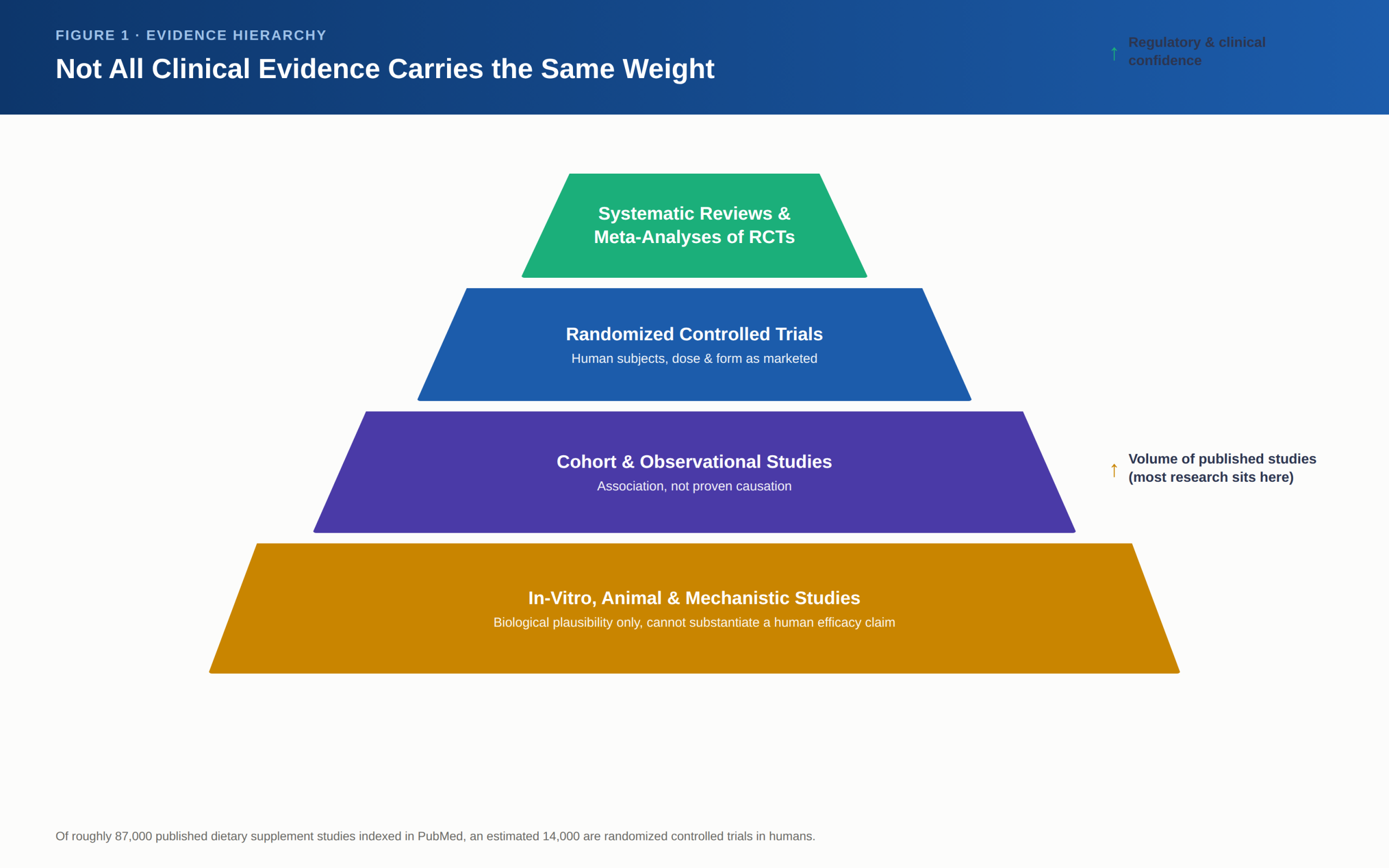
Figure 1. The evidence hierarchy: most published nutraceutical research sits at the bottom of the pyramid, while regulators and clinicians place their confidence at the top.
Why Regulators Set the Bar Where They Do
Marketers cannot simply point to “a study” and expect it to carry commercial or regulatory weight, because the two agencies that police these claims in Mevian’s largest markets, the U.S. Federal Trade Commission and the European Food Safety Authority, have each defined in detail what counts.
The FTC requires “competent and reliable scientific evidence” before a claim is published, not after. In practice this means human randomized controlled trials using the dose, form, and target population described on the label, and for stronger efficacy claims, weight management, cognitive performance, sexual health, cardiovascular or immune support, FTC consent orders have repeatedly required at least two independent, well-designed RCTs with consistent results [3][6]. A mechanistic or animal study can support biological plausibility, but it cannot substantiate a claim about how the finished product performs in people [3].
EFSA’s Article 13 and Article 14 health claim process is, if anything, stricter. Since Regulation (EC) No 1924/2006 took effect, EFSA has evaluated more than 4,000 health claim applications and approved roughly 250, a rejection rate near 80% [4][7]. The agency requires a demonstrated cause-and-effect relationship, a fully characterized substance (for botanicals, the plant species, part used, extraction method, and active-constituent profile), and consistent findings across multiple independent studies conducted in the population and at the dose actually marketed [4]. The most common reasons EFSA rejects a submission recur across the industry: reliance on in-vitro, animal, or observational data instead of human trials; poorly characterized botanical inputs; evidence that supports a different effect than the one claimed; studies conducted in patients rather than healthy subjects; and a mismatch between the studied dose and the marketed dose [4].
For a distributor moving products across both markets, this divergence is not academic. A claim substantiated to FTC standards will often need additional work, or a materially softer claim, to clear EFSA review, and the reverse is equally true. As explored in Mevian’s earlier analysis of clinically positioned product development, building evidence into product development from the outset, rather than retrofitting it after formulation, is consistently the more efficient path.
How the U.S. and EU Evidence Standards Compare
United States (FTC) | European Union (EFSA) | |
Governing standard | “Competent and reliable scientific evidence” under the FTC Act | Regulation (EC) No 1924/2006, Articles 13 & 14 |
Evidence required | Human RCTs at the labeled dose, form, and population | Human RCTs demonstrating cause-and-effect, plus full substance characterization |
Typical minimum bar | Generally two independent RCTs for strong efficacy claims | Multiple independent studies with consistent findings; ~80% of submissions rejected |
Enforcement point | Evidence must exist before the claim is published | Claim must be pre-approved and listed on the EU Register before use |
Common failure mode | A study commissioned after a claim is challenged, not before | In-vitro/animal-only data, dose mismatch, or the wrong study population |
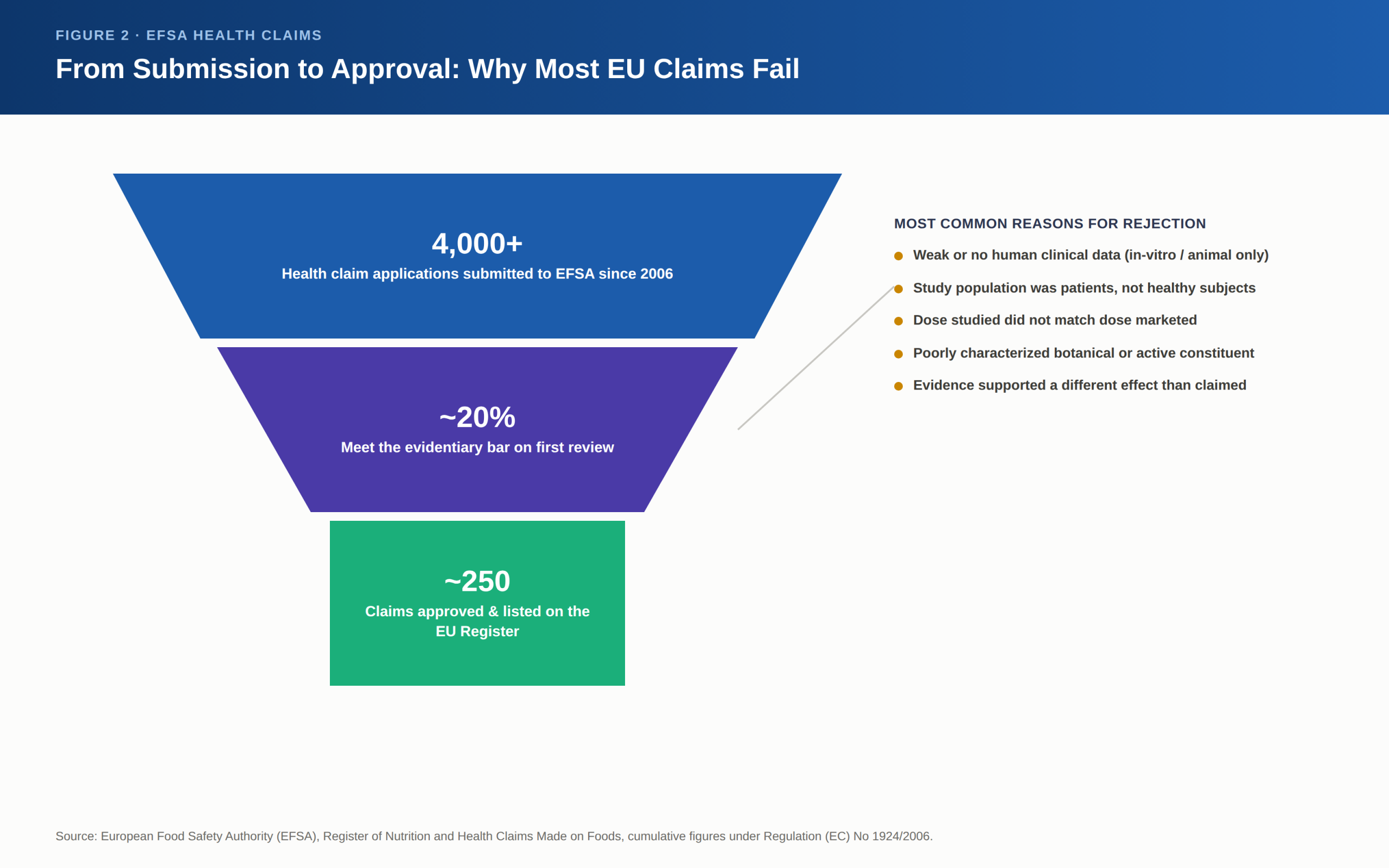
Figure 2. Roughly four in five EFSA health claim submissions are rejected, most often for evidence gaps that better trial design could have closed before filing.
The Economics of Proof: What a Study Costs, and Who Pays for It
The case for clinical evidence is strong, but it is worth being direct about what it costs, because that cost shapes which companies invest in evidence and which do not. Component pricing for a supplement trial typically breaks down as follows: protocol development, $10,000 to $30,000; participant recruitment and screening, $200 to $500 per participant; clinical site fees, $1,000 to $3,000 per participant visit; laboratory and biomarker analysis, $100 to $500 per sample; data management and biostatistics, $15,000 to $50,000; regulatory and IRB review, $5,000 to $15,000; and project management, $10,000 to $25,000 [8]. Even a modest, adequately powered RCT typically exceeds $150,000 once these components are combined [9], and studies designed to support a specific efficacy claim, with larger cohorts and longer follow-up, regularly run into the high six or low seven figures.
THE FREE-RIDER PROBLEM
Most botanical and many nutrient ingredients cannot be patented, which creates a structural disincentive to fund the research the market says it wants. If one company spends $300,000 proving that an ingredient supports sleep or immune function, every competitor formulating with that same commodity ingredient benefits from the finding at no cost [9]. This is a large part of why clinical substantiation remains uneven across the industry, even in categories where demand for evidence is high. It also explains why proprietary, patent-protected, or exclusively sourced ingredients attract a disproportionate share of industry clinical investment: they are the only ones where the company funding the study can capture the return.
This is precisely why efficient trial design matters as much as trial existence. Companies that secure meaningful evidence at manageable cost typically pair a smaller proof-of-concept study with a confirmatory follow-up rather than committing to one large trial up front, size their sample using existing literature rather than defaulting to round numbers, and run regulatory submission, ethics review, and manufacturing in parallel rather than in sequence, a choice that alone can compress timelines by eight to twelve weeks [10].
Clinical Evidence vs. Third-Party Certification: Two Different Kinds of Trust
B2B buyers frequently conflate two forms of proof that answer different questions. A third-party quality certification, GMP compliance, NSF or USP verification, or an Informed-Sport or Informed-Choice seal, answers the question of whether a product reliably contains what the label says, free of contaminants, at the stated potency [11]. It says nothing about whether the ingredient, at that dose, produces the health effect being marketed. A clinical study answers that second question and is silent on the first.
The strongest supplier relationships, and the products that hold up best under distributor and pharmacy due diligence, combine both. Quality certification without clinical substantiation is a promise about manufacturing, not efficacy. Clinical substantiation without quality certification is a promise about efficacy that cannot be trusted to be delivered consistently, batch to batch, in the product actually on the shelf.
What This Means for Distributors, Wholesalers, and Pharmacy Partners
For a B2B buyer, the value of clinical evidence is not only reputational. Carrying a product whose marketing claims outrun its substantiation creates direct commercial exposure: in the U.S., the FTC can and does pursue distributors and retailers, not only manufacturers, when advertising claims lack adequate support, and in the EU an unauthorized health claim on packaging or point-of-sale material can trigger removal from sale in that market entirely [6][7].
Evidence quality is also becoming a differentiator in tender and formulary processes. Hospital and pharmacy procurement committees increasingly request the underlying study, not just a claim summary, before listing a nutraceutical product, and distributors that can supply a ready, translatable, jurisdiction-appropriate evidence package alongside a product consistently move through listing and approval faster than those sourcing it after the fact.
An Evidence Due-Diligence Checklist for Sourcing Decisions
Before adding a clinically substantiated product to a catalogue, these six questions help separate genuine evidence from marketing language.
Question to Ask the Supplier | Why It Matters |
Was the study conducted in humans, at the exact dose and form used in the finished product? | In-vitro and animal data alone cannot substantiate a human efficacy claim under FTC or EFSA standards. |
Was the study published in a peer-reviewed journal, or only presented at a conference or posted on a company website? | Peer review is the minimum quality filter regulators and clinicians expect before treating a finding as reliable. |
How large was the study, and was it powered to detect the effect being claimed? | Small pilot studies can produce a headline finding without the statistical power to support it commercially or legally. |
Was the study conducted independently, or fully funded and run in-house by the ingredient supplier? | Independent or third-party-monitored trials carry more weight with regulators, clinicians, and increasingly with buyers. |
Does the claim on the label match what the study actually measured? | A mismatch between the studied outcome and the marketed claim is the single most common reason EFSA submissions fail. |
Is the evidence current, or does it rely on decades-old research on a different formulation? | Reformulated or updated products need their own substantiation; evidence does not automatically transfer. |
Sourcing Products Built on Evidence, Not Assumptions
Mevian works with distributors, wholesalers, and pharmacy partners across international markets to source and move nutraceutical and FSMP products where the clinical and regulatory groundwork has already been done, not promised.
If your organization is evaluating a new nutraceutical category or auditing the evidence behind your current portfolio, Mevian’s team can help you separate substantiated products from well-marketed ones. Get in touch to discuss your sourcing requirements.