
TWO CONDITIONS, ONE ORGAN From diabetes: sustained high blood glucose forces the kidneys’ filtering units to work under constant strain, gradually scarring them from the inside out. From hypertension: sustained high blood pressure is transmitted directly into the kidneys’ smallest blood vessels, thickening and narrowing them until filtering capacity declines. Together, these two conditions are now estimated to account for about 75% of new kidney failure diagnoses in the United States, a proportion echoed, with regional variation, in most parts of the world. |
Chronic kidney disease has quietly become one of the largest chronic disease burdens in medicine. An estimated 788 million adults worldwide were living with some degree of kidney disease in 2023, a crude prevalence of 14.6%, and the condition caused an estimated 1.48 million deaths that year, making it the ninth leading cause of death globally. In Western Europe, kidney disease deaths are projected to rise by nearly 36% by 2050, even as deaths from heart disease and stroke fall, a trajectory that puts kidney disease on track to become the region’s third leading cause of death within roughly a generation.
Much of that burden is preventable, or at least postponable, because its two leading drivers, diabetes and hypertension, are modifiable. Yet awareness remains strikingly low: in the United States, an estimated 87% of adults with kidney disease do not know they have it, because early-stage disease rarely causes symptoms. This article updates the clinical picture of how diabetes and hypertension damage the kidneys, how modern medicine now stages and treats that damage, and, deliberately given equal weight here, what current evidence says about nutritional management, an intervention axis that deserves the same rigor as any prescription.
What Chronic Kidney Disease Actually Means
Clinically, chronic kidney disease (CKD) is defined as abnormalities of kidney structure or function, present for three months or longer, with implications for health. In practice, clinicians stage that abnormality along two independent axes rather than one: how well the kidneys filter blood (estimated glomerular filtration rate, or eGFR, expressed in mL/min/1.73m²) and how much albumin leaks into the urine (urine albumin-to-creatinine ratio, or ACR, expressed in mg/g). The Kidney Disease: Improving Global Outcomes (KDIGO) initiative combines both axes into a single risk grid, often called the CKD heat map, shown below.
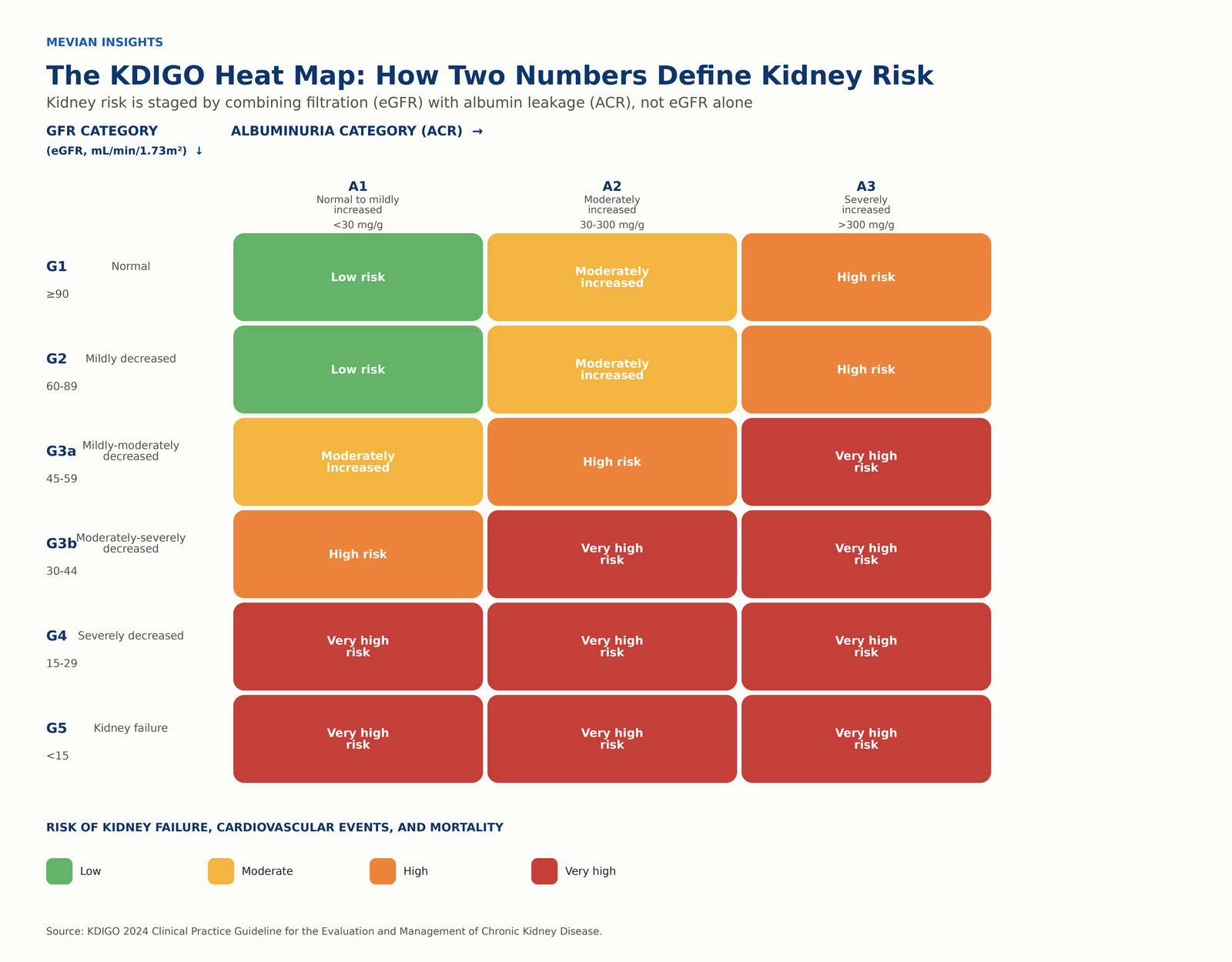
Figure 1. The KDIGO risk heat map combines GFR category (rows) with albuminuria category (columns) to stratify risk of kidney failure, cardiovascular events, and mortality into four color-coded tiers.
Two patients with an identical eGFR can carry very different risk once albuminuria is factored in, which is why albuminuria testing, not eGFR alone, is now considered essential rather than optional. This matters directly for distribution and pharmacy partners: a patient’s position on this grid determines how often they should be monitored, how aggressively their diabetes or blood pressure should be treated, and, as the next sections cover, how their diet should be adjusted.
How Diabetes Damages the Kidneys
Diabetic kidney disease develops in an estimated 20% to 40% of people with diabetes and has become the single leading cause of chronic kidney disease worldwide. The damage begins with sustained hyperglycemia, which triggers several overlapping pathways: advanced glycation end-products accumulate and provoke inflammation, the polyol pathway and protein kinase C activation amplify oxidative stress, and, critically, the kidneys’ own blood flow regulation is disrupted. Hyperglycemia dilates the vessels feeding each glomerulus while the renin-angiotensin system constricts the vessels draining it, raising pressure inside the filtering unit itself, a state called glomerular hyperfiltration, that over years thickens the basement membrane and injures the podocyte cells responsible for filtration.
In the United States, an estimated 49% of adults with type 1 diabetes and 41% of adults with type 2 diabetes are now estimated to have some degree of CKD. Early disease is silent, detectable only through albuminuria screening; by the time increased urination, leg or ankle swelling, fatigue, or nausea appear, meaningful filtration capacity has typically already been lost. Because insulin resistance and elevated blood glucose begin doing this kind of vascular damage well before a formal diabetes diagnosis is made, Mevian’s dedicated guide to prediabetes covers the upstream window where intervention is often most effective.
How Hypertension Damages the Kidneys
Hypertensive kidney disease, or hypertensive nephrosclerosis, works through a more mechanical route. Sustained systemic high blood pressure is transmitted directly into the kidneys’ smallest arteries and glomerular capillaries, causing the vessel walls to thicken and narrow, a process called arteriolosclerosis, that progressively reduces blood flow to functioning nephrons and drives glomerulosclerosis, scarring of the filtering units themselves. Unlike a blocked artery elsewhere in the body, this damage produces no localized pain, which is precisely why the disease has earned its reputation as a silent one: symptoms typically do not appear until CKD is already advanced, manifesting then as headaches, fatigue, or fluid retention.
Hypertension is estimated to account for roughly 27% of chronic kidney disease cases directly, and separately, an estimated 21% of US adults with high blood pressure are thought to have some degree of CKD. The relationship also runs in both directions: as kidney function declines, the kidneys retain more sodium and fluid and activate the same renin-angiotensin system implicated in diabetic kidney disease, which raises blood pressure further. This self-reinforcing loop is one reason blood pressure control remains a cornerstone of CKD management regardless of its original cause.
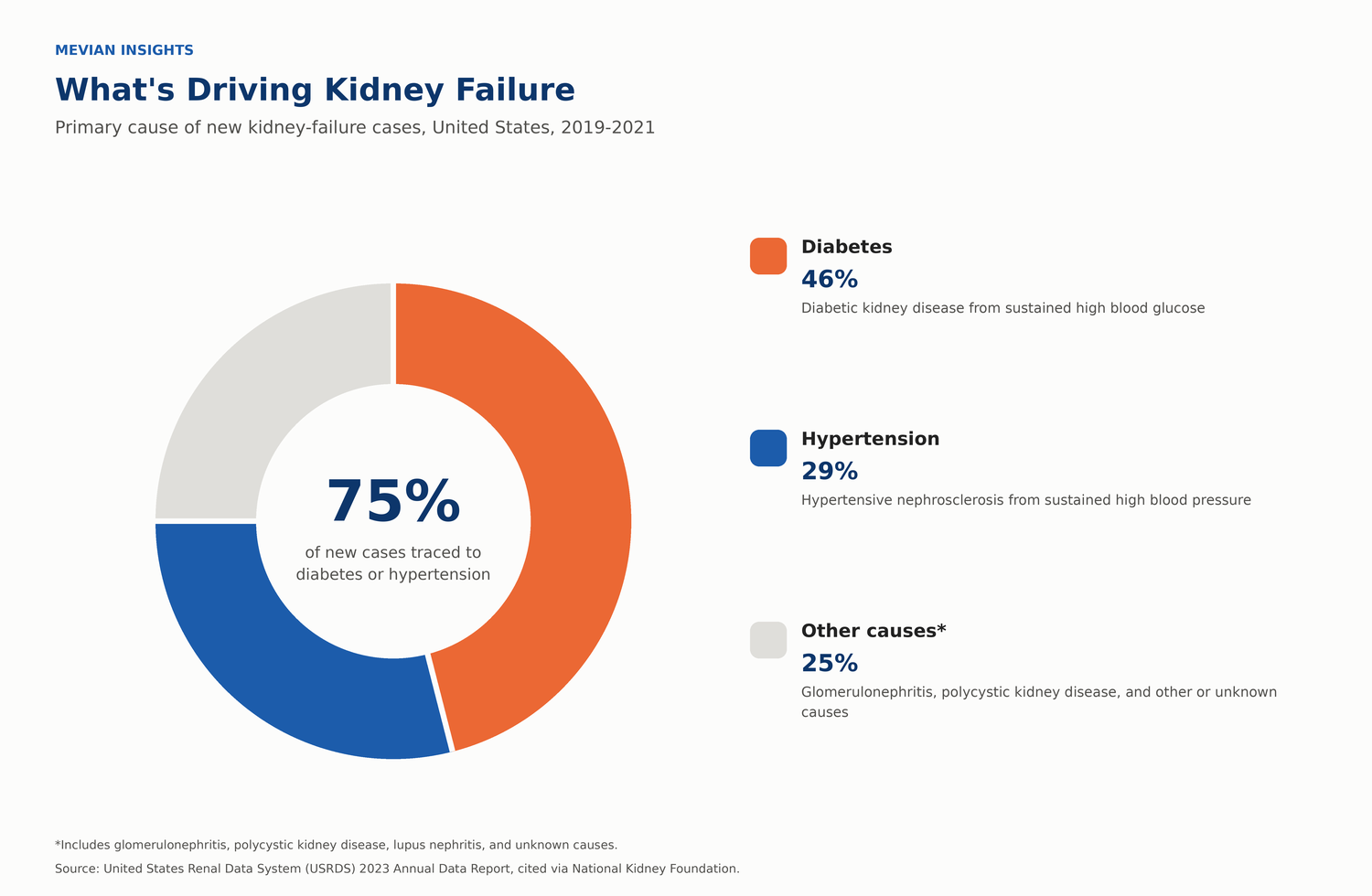
Figure 2. Diabetes and hypertension together account for an estimated three quarters of new kidney failure diagnoses in the United States; the remainder spans glomerulonephritis, polycystic kidney disease, and other or unknown causes.
Modern Pharmacological Management: Beyond Glucose and Blood Pressure Control
Treatment has moved well past generic advice to “control blood sugar and blood pressure.” Four drug classes, increasingly used in combination, now have dedicated kidney-outcome trial evidence behind them.
- RAAS inhibitors (ACE inhibitors and ARBs). The original evidence base: in the Collaborative Study Group trial, captopril reduced the risk of serum creatinine doubling by 48% in type 1 diabetes with nephropathy, and in the RENAAL trial, losartan reduced creatinine doubling by 25% and progression to kidney failure by 28% in type 2 diabetic kidney disease. RAAS inhibition remains the foundation on which newer agents are added.
- SGLT2 inhibitors. Three major trials now support their use for kidney protection independent of glycemic benefit: canagliflozin reduced a composite kidney outcome by 30% (CREDENCE), dapagliflozin by 39% (DAPA-CKD), and empagliflozin by 28% (EMPA-KIDNEY). The 2026 KDIGO draft update recommends continuing these agents even as eGFR falls below the level at which they were started, provided they remain tolerated.
- GLP-1 receptor agonists. The FLOW trial, the first GLP-1 trial powered specifically for kidney endpoints, found that semaglutide reduced a composite renal outcome (kidney failure, sustained large eGFR decline, or renal or cardiovascular death) by 24%, and all-cause mortality by 20%.
- Nonsteroidal mineralocorticoid receptor antagonists (finerenone). FIDELIO-DKD showed an 18% reduction in a composite kidney outcome, FIGARO-DKD a 13% reduction in major cardiovascular events, and the pooled FIDELITY analysis a 23% reduction in the kidney composite and 18% lower all-cause mortality. Potassium monitoring is essential alongside this drug class.
A network meta-analysis of triple therapy, RAAS inhibitor plus SGLT2 inhibitor plus a nonsteroidal MRA, estimated a 46% reduction in combined cardiovascular and kidney events compared with monotherapy, evidence that is actively reshaping how quickly clinicians layer these agents rather than titrating one at a time. Blood pressure targets below 130/80 mmHg remain the guideline standard for people with both diabetes and CKD.
Nutritional Management: The Overlooked Lever
Older overviews of kidney disease, including earlier versions of this one, tend to list “dietary changes” as one bullet point alongside medication and exercise, as if diet were a lifestyle nicety rather than a graded clinical intervention. Current guidance treats it very differently: the Kidney Disease Outcomes Quality Initiative (KDOQI) 2020 nutrition guideline and the 2026 KDIGO diabetes-and-CKD update both set specific, evidence-based nutrient targets, and international nutrition societies now publish dedicated practical guidelines for exactly when and how to intervene nutritionally in kidney disease.
MYTH VS. FACT Myth: the safest diet for kidney disease is the lowest-protein diet possible. Fact: unsupervised, overly aggressive protein restriction carries its own risk. Protein-energy wasting, a state of depleted muscle and fat mass, has been found in roughly 30% of advanced CKD patients in one closely studied cohort, and it is associated with worse outcomes. KDOQI’s actual guidance is not “restrict as much as possible,” but a specific, supervised range that differs by diabetes status and dialysis status, set out below. |
For adults with CKD stages 3 to 5 who are not yet on dialysis, KDOQI recommends 0.55 to 0.60 g of protein per kilogram of body weight per day for people without diabetes (or as low as 0.28 to 0.43 g/kg/day with supplemental keto-acid analogs, under specialist supervision), and a somewhat less restrictive 0.6 to 0.8 g/kg/day for people with diabetes, reflecting diabetic patients’ higher baseline risk of muscle loss. Once a patient starts dialysis, the target reverses sharply, to 1.0 to 1.2 g/kg/day, because dialysis itself removes amino acids and increases protein turnover. None of these numbers are meant to be applied without a dietitian; they are starting points for individualized care, not blanket rules.
Nutrient | Typical target, non-dialysis CKD | Why it is managed |
Protein | 0.55-0.60 g/kg/day (non-diabetic) or | Slows the rate of eGFR decline while limiting the risk of muscle and fat loss |
Sodium | Below roughly 2.0-2.3 g/day | Limits fluid retention and supports blood pressure control |
Potassium | Individualized; often restricted from stage 3b onward | Declining GFR, plus RAAS inhibitors and finerenone, raise hyperkalemia risk |
Phosphorus | Individualized; hidden “PHOS” additives avoided | Prevents bone and mineral disorder and vascular calcification |
Energy | Roughly 25-35 kcal/kg/day | Protects lean muscle mass, especially when protein intake is restricted |
One counterintuitive but well-supported refinement is where that protein comes from. A plant-dominant low-protein diet, sourcing at least half of a patient’s protein allowance from plants, has shown several advantages over an equivalent amount of animal protein: it produces less dietary acid load, supported by measurably higher blood bicarbonate in plant-based groups; it lowers phosphorus absorption, because plant phosphorus is bound as phytate and only 20% to 50% bioavailable, compared with 60% to 80% for animal sources; and, despite common assumptions, plant potassium is also less bioavailable than potassium from meat or dairy, and cooking methods such as boiling further reduce it. In a randomized trial of 207 patients with stage 4 CKD, a vegetarian very-low-protein diet supplemented with keto-acid analogs slowed eGFR decline more than a standard low-protein diet.
Diet alone is not always enough, and this is where formulated nutrition earns its place alongside dietary counseling rather than in place of it. When a patient’s intake remains inadequate despite counseling, KDOQI supports a structured, typically three-month trial of oral nutritional supplements before considering enteral or, in more severe cases, parenteral nutrition. A 2024 European Society for Clinical Nutrition and Metabolism (ESPEN) practical guideline, covering 32 separate evidence-based recommendations, similarly emphasizes individualized nutritional assessment and monitoring over one-size-fits-all prescriptions, explicitly warning against both underfeeding and overfeeding. Foods for Special Medical Purposes (FSMPs) formulated specifically for renal dietary management, such as Mevian’s Nutromev Renal, are built around this problem: a standard 85g bottle delivers 400 kcal alongside a renal-adapted 6.0g of protein, 360mg of sodium, 320mg of potassium, and 120mg of phosphorus, a combination designed to let a patient take in concentrated, usable energy without the electrolyte load an equivalent amount of ordinary food would carry, always under medical supervision rather than as a stand-alone diet.
When Kidney Disease Needs Urgent Attention
! Little or no urine output over several hours
! Sudden or severe swelling in the legs, ankles, or around the eyes
! Shortness of breath, which can signal fluid overload around the lungs or heart
! New confusion or severe, unexplained fatigue
! Chest pain, which in advanced kidney disease can indicate uremic pericarditis
Any of these warrants prompt medical evaluation rather than a wait-and-see approach.
CKD Stage by Stage: What to Prioritize
Stage (GFR category) | Primary focus |
G1-G2 (eGFR ≥60) | Confirm and control the underlying driver (glucose, blood pressure); annual albuminuria screening; no routine protein restriction needed yet |
G3a-G3b (eGFR 30-59) | Dietitian referral; begin sodium and, as needed, potassium monitoring; optimize RAAS inhibitor, SGLT2 inhibitor, or finerenone therapy; introduce a supervised moderate protein target |
G4-G5 (eGFR <30) | Stricter phosphorus and potassium control; formal malnutrition screening; consider oral nutritional supplements or an FSMP if intake is inadequate; begin transplant or dialysis-access planning conversations |
Partnering on Nutrition-Forward Renal Care
What happens when a kidney patient is losing weight despite eating enough?
Often the issue is not the amount of food but its composition: ordinary meals rarely deliver concentrated calories without also delivering more sodium, potassium, or phosphorus than a compromised kidney can safely handle. Mevian supports pharmacy, hospital, and distribution partners across the renal care pathway, from FSMPs such as Nutromev Renal formulated specifically for that gap, through to the broader clinical nutrition portfolio that supports patients earlier in the diabetes and hypertension continuum. Reach out to discuss formulation data, regulatory documentation, or distribution across Mevian’s international markets.